Philosopher
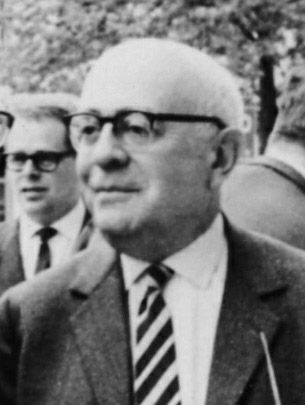
Theodor W. Adorno
1903–1969
Also known as Theodor Ludwig Wiesengrund
Frankfurt School philosopher, sociologist and music critic whose Dialectic of Enlightenment, written with Horkheimer, argued that modern reason had turned into a new form of domination.

Enlightenment, understood in the widest sense as the advance of thought, has always aimed at liberating human beings from fear and installing them as masters. Yet the wholly enlightened earth is radiant with triumphant calamity.
Adorno was born Theodor Ludwig Wiesengrund in Frankfurt in 1903, the only child of a wine merchant of assimilated Jewish background and a Catholic singer of Corsican descent. He studied philosophy in Frankfurt and composition with Alban Berg in Vienna, and wrote his habilitation thesis on Kierkegaard’s aesthetics in close friendship with Walter Benjamin. Expelled from teaching by the Nazis, he left Germany in 1934 and spent the Nazi years in Oxford, New York and southern California, where he wrote Dialectic of Enlightenment with Max Horkheimer and Minima Moralia.
He returned to Frankfurt in 1949, became a leading public intellectual in West Germany and, in 1958, director of the Institute for Social Research, where Jürgen Habermas was his student and assistant. In the 1960s he led the challenge to both Karl Popper’s philosophy of science and Heidegger’s philosophy of existence, and drew fire from student radicals and from their critics on the right. He died of a heart attack in 1969; Aesthetic Theory appeared the following year.
Key ideas
- The dialectic of enlightenment
- Enlightenment set out to free human beings from fear and make them masters, “yet the wholly enlightened earth is radiant with triumphant calamity”. The development of reason itself, Adorno and Horkheimer argued, has reversed into new forms of domination.
- The culture industry
- Film, radio and magazines form a system. Mass entertainment is rationalised and standardised like any commodity, planned to produce titillation and distraction rather than meaning, unlike authentic modernist art or spontaneous folk art.
- Negative dialectics
- Adorno’s “metacritique” of Kant and Hegel aims “to use the strength of the subject to break through the deception of constitutive subjectivity”. Thought should honour what escapes its concepts, “the nonidentical”, rather than forcing objects into identity with them.
- After Auschwitz
- Adorno wrote no systematic ethics, but many readers find his work ethical through and through, as a response to the industrialised mass murder he called “Auschwitz”, where a way of thinking that treats each person as a mere specimen reached its end point.
- Tradition
- Western
- Region
- Germany and United States
- Schools
- Frankfurt School
- Period
- Contemporary
Influences
Influenced by
- Immanuel Kant1724–1804criticised
- G. W. F. Hegel1770–1831criticised
- Søren Kierkegaard1813–1855criticised
- Karl Marx1818–1883
- Edmund Husserl1859–1938criticised
- Martin Heidegger1889–1976criticised
Theodor W. Adorno1903–1969
Influenced
Influenced by
- Immanuel Kant1724–1804criticised
- G. W. F. Hegel1770–1831criticised
- Søren Kierkegaard1813–1855criticised
- Karl Marx1818–1883
- Edmund Husserl1859–1938criticised
- Martin Heidegger1889–1976criticised
Theodor W. Adorno1903–1969
Influenced
Where these links come from
- Theodor W. Adorno drew on and argued against Immanuel Kant. Source: Henry Pickford and Lambert Zuidervaart, Theodor W. Adorno, Stanford Encyclopedia of Philosophy
- Theodor W. Adorno drew on and argued against G. W. F. Hegel. Source: Henry Pickford and Lambert Zuidervaart, Theodor W. Adorno, Stanford Encyclopedia of Philosophy
- Theodor W. Adorno drew on and argued against Søren Kierkegaard. Source: Henry Pickford and Lambert Zuidervaart, Theodor W. Adorno, Stanford Encyclopedia of Philosophy
- Theodor W. Adorno drew on Karl Marx. Source: Henry Pickford and Lambert Zuidervaart, Theodor W. Adorno, Stanford Encyclopedia of Philosophy
- Theodor W. Adorno argued against Edmund Husserl. Source: Henry Pickford and Lambert Zuidervaart, Theodor W. Adorno, Stanford Encyclopedia of Philosophy
- Theodor W. Adorno argued against Martin Heidegger. Source: Henry Pickford and Lambert Zuidervaart, Theodor W. Adorno, Stanford Encyclopedia of Philosophy
- Jürgen Habermas studied with and argued against Theodor W. Adorno. Source: Henry Pickford and Lambert Zuidervaart, Theodor W. Adorno, Stanford Encyclopedia of Philosophy
Key works
- Dialectic of Enlightenment (Dialektik der Aufklärung), 1947
- Minima Moralia, 1951
- Negative Dialectics (Negative Dialektik), 1966
- Aesthetic Theory (Ästhetische Theorie), 1970
Sources
- Henry Pickford and Lambert Zuidervaart, Theodor W. Adorno, Stanford Encyclopedia of Philosophy
- Robin Celikates and Jeffrey Flynn, Critical Theory (Frankfurt School), Stanford Encyclopedia of Philosophy