Philosopher
Edmund Husserl
1859–1938
Founder of phenomenology, who studied consciousness as it is experienced, bracketing our taken-for-granted belief in the world to reveal how things show up for us.
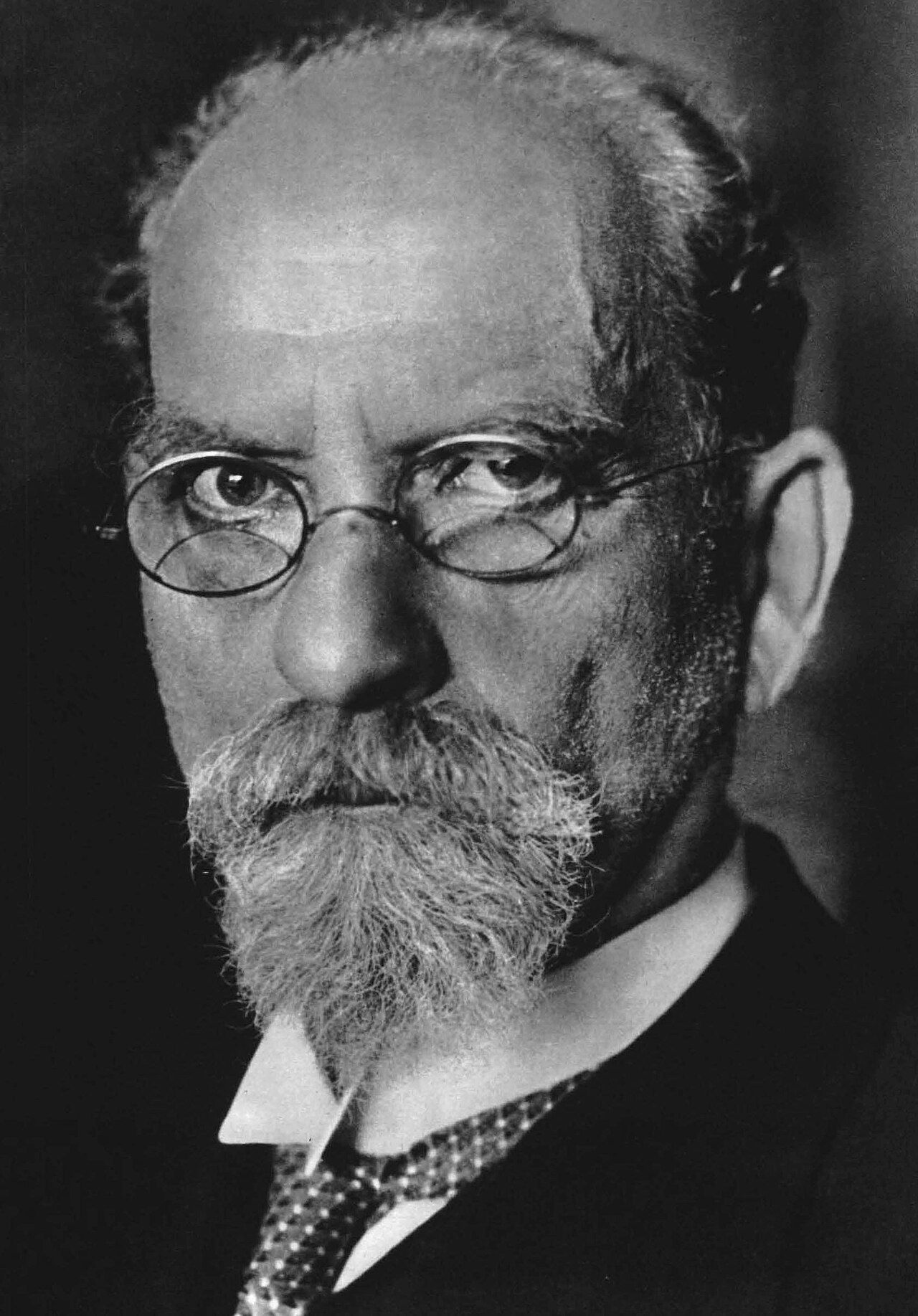

The true method follows the nature of the things to be investigated and not our prejudices and preconceptions.
Husserl was born into a Jewish family in Proßnitz, Moravia, on 8 April 1859. He studied mathematics and took a doctorate in it, but Franz Brentano’s lectures in Vienna turned him to philosophy. His Logical Investigations of 1900–01, his “breakthrough” to phenomenology, made Göttingen a centre of the movement; in 1913 Ideas I took a transcendental turn that troubled many early followers. In 1916 he moved to Freiburg, where Martin Heidegger became his successor.
Under the National Socialist regime he was barred from academic activity because of his Jewish background, though he had converted to Protestantism in 1886. He died on 27 April 1938, leaving some 45,000 pages of manuscripts. As the founder of phenomenology he shaped the work of Heidegger, Edith Stein, Maurice Merleau-Ponty, Jean-Paul Sartre and many others, and he credited Descartes with first turning philosophy radically towards the subject.
Key ideas
- Against psychologism
- Logic is not a branch of psychology. Its laws are ideal and exact, not empirical regularities of how people happen to think, and the act of knowing must be distinguished from what is known.
- Intentionality
- Consciousness is always consciousness of something. Phenomenology describes the structures of this directedness, how objects are given in perception, memory, imagination and judgement.
- The epoché and the reduction
- In everyday life we simply take the world’s existence for granted. By suspending, or bracketing, this natural attitude, the phenomenologist can study how the world is given to consciousness and what makes that givenness possible.
- To the things themselves
- Inquiry should be guided by its subject matter, not by prior theories. Husserl warned against treating the methods and ideals of the exact sciences as the measure of what is true and real.
- The lifeworld
- Science rests on the lifeworld, the world of everyday experience that we live and feel at home in, full of meaning, history and things to use, which science takes for granted and cannot replace.
- Tradition
- Western
- Region
- Göttingen and Freiburg, Germany
- Schools
- Phenomenology
- Period
- Late modern
Influences
Influenced by
Edmund Husserl1859–1938
Influenced
Influenced by
Edmund Husserl1859–1938
Influenced
Where these links come from
- Edmund Husserl drew on and argued against René Descartes. Source: Dan Zahavi, Edmund Husserl, Stanford Encyclopedia of Philosophy
- Edmund Husserl drew on William James. Source: Russell Goodman, William James, Stanford Encyclopedia of Philosophy
- Nishida Kitarō drew on Edmund Husserl. Source: John C. Maraldo, Nishida Kitarō, Stanford Encyclopedia of Philosophy
- Martin Heidegger studied with, drew on and argued against Edmund Husserl. Source: Mark Wrathall, Martin Heidegger, Stanford Encyclopedia of Philosophy
- Theodor W. Adorno argued against Edmund Husserl. Source: Henry Pickford and Lambert Zuidervaart, Theodor W. Adorno, Stanford Encyclopedia of Philosophy
- Jean-Paul Sartre drew on and argued against Edmund Husserl. Source: Jack Reynolds and Pierre-Jean Renaudie, Jean-Paul Sartre, Stanford Encyclopedia of Philosophy
- Maurice Merleau-Ponty drew on and argued against Edmund Husserl. Source: Ted Toadvine, Maurice Merleau-Ponty, Stanford Encyclopedia of Philosophy
- Albert Camus argued against Edmund Husserl. Source: Ronald Aronson, Albert Camus, Stanford Encyclopedia of Philosophy
- Jacques Derrida drew on and argued against Edmund Husserl. Source: Leonard Lawlor, Jacques Derrida, Stanford Encyclopedia of Philosophy
Key works
- Logical Investigations (Logische Untersuchungen), 1900
- Ideas I (Ideen zu einer reinen Phänomenologie und phänomenologischen Philosophie), 1913
- Cartesian Meditations, 1931
- The Crisis of European Sciences and Transcendental Phenomenology, 1936
Sources
- Dan Zahavi, Edmund Husserl, Stanford Encyclopedia of Philosophy
- Russell Goodman, William James, Stanford Encyclopedia of Philosophy