Philosopher
Jean-Paul Sartre
1905–1980
Also known as Sartre
French existentialist philosopher, novelist and public intellectual, who held that human beings are condemned to be free and responsible for what they make of themselves.
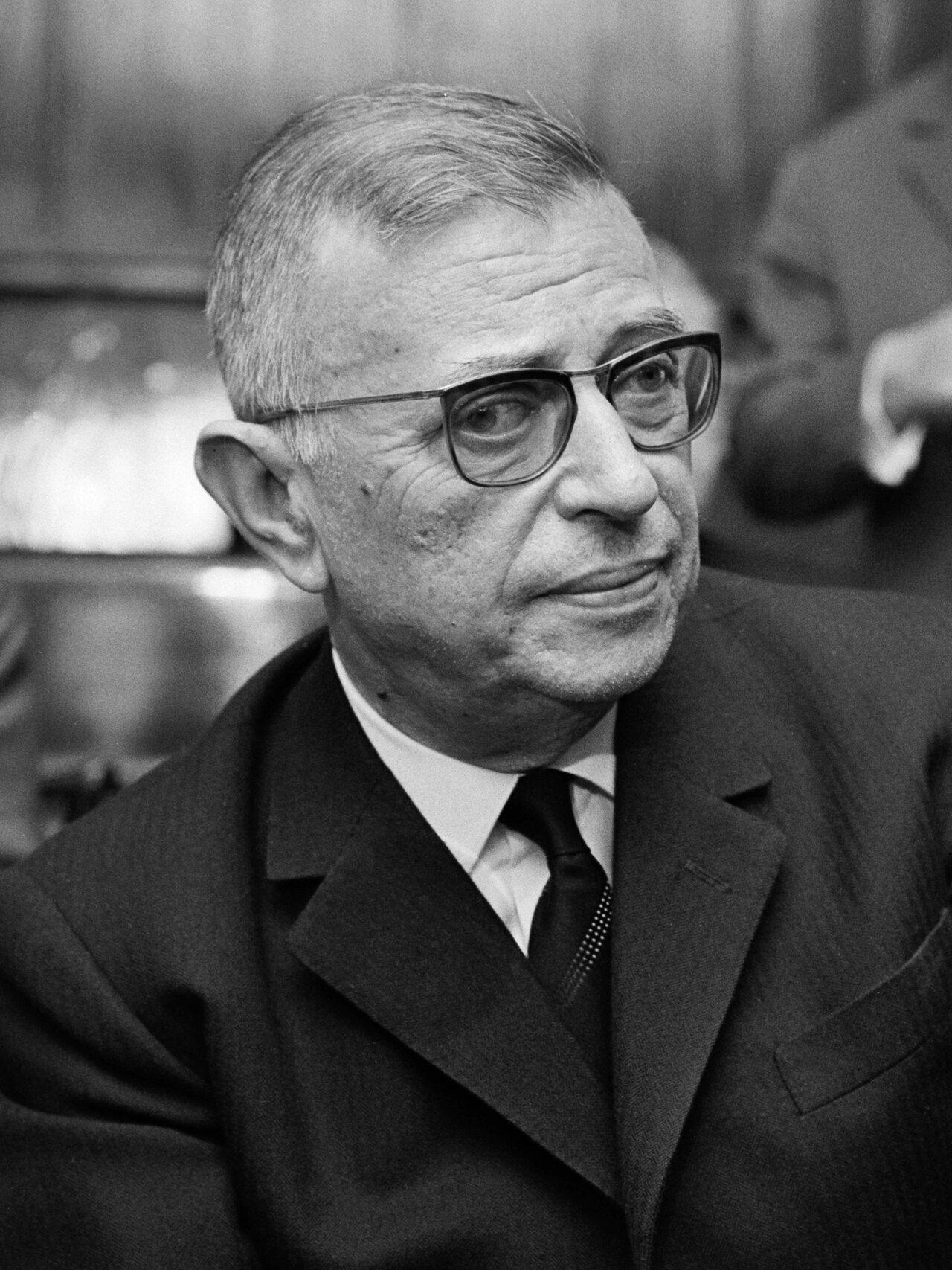
To be dead is to be prey for the living.
Sartre was born in 1905 and lived through the major upheavals of the twentieth century, which his philosophy responded to and tried to shape. He trained in phenomenology through Husserl’s work, and published studies of the ego, the emotions and the imagination before Being and Nothingness (1943), the defining treatise of existentialism. His lecture Existentialism Is a Humanism drew crowds of thousands in Paris in 1945.
He was also a novelist and playwright, founded and co-edited the review Les Temps modernes, and campaigned against racism and colonialism. He was the public intellectual par excellence of post-war France, and in 1964 he tried to refuse the Nobel Prize for Literature. He died in 1980; Simone de Beauvoir’s Adieux was the first of many accounts of his life.
Key ideas
- Condemned to be free
- Consciousness, the “for-itself”, is not a thing but a negating and transcending activity, radically different from the fixed being of objects. We cannot escape this freedom, with the anguish and responsibility it brings.
- Existence precedes essence
- There is no given human nature that fixes what we are; we make ourselves through our choices and actions. Our freedom is realised only in what we project and do.
- Bad faith
- We often flee our freedom by lying to ourselves, treating ourselves as fixed things or denying our situation. Sartre rejected Freud’s explanation by an unconscious, which he thought only moved the problem elsewhere.
- The look of the other
- When another person looks at me I become an object for them, and feel shame. Building on Hegel, Husserl and Heidegger, Sartre made this experience central to his account of our relations with others.
- Existentialism and Marxism
- In his later Critique of Dialectical Reason Sartre tried to combine historical materialism, which he took to be the only valid interpretation of history, with existentialism, the only concrete approach to reality.
- Tradition
- Western
- Region
- Paris
- Period
- Contemporary
Influences
Influenced by
- G. W. F. Hegel1770–1831
- Karl Marx1818–1883
- Edmund Husserl1859–1938criticised
- Henri Bergson1859–1941
- Martin Heidegger1889–1976
Jean-Paul Sartre1905–1980
Influenced
Influenced by
- G. W. F. Hegel1770–1831
- Karl Marx1818–1883
- Edmund Husserl1859–1938criticised
- Henri Bergson1859–1941
- Martin Heidegger1889–1976
Jean-Paul Sartre1905–1980
Influenced
Where these links come from
- Jean-Paul Sartre drew on G. W. F. Hegel. Source: Jack Reynolds and Pierre-Jean Renaudie, Jean-Paul Sartre, Stanford Encyclopedia of Philosophy
- Jean-Paul Sartre drew on Karl Marx. Source: Jack Reynolds and Pierre-Jean Renaudie, Jean-Paul Sartre, Stanford Encyclopedia of Philosophy
- Jean-Paul Sartre drew on and argued against Edmund Husserl. Source: Jack Reynolds and Pierre-Jean Renaudie, Jean-Paul Sartre, Stanford Encyclopedia of Philosophy
- Jean-Paul Sartre drew on Henri Bergson. Source: Leonard Lawlor and Valentine Moulard-Leonard, Henri Bergson, Stanford Encyclopedia of Philosophy
- Jean-Paul Sartre drew on Martin Heidegger. Source: Jack Reynolds and Pierre-Jean Renaudie, Jean-Paul Sartre, Stanford Encyclopedia of Philosophy
- Maurice Merleau-Ponty drew on and argued against Jean-Paul Sartre. Source: Ted Toadvine, Maurice Merleau-Ponty, Stanford Encyclopedia of Philosophy
- Simone de Beauvoir drew on Jean-Paul Sartre. Source: Debra Bergoffen and Megan Burke, Simone de Beauvoir, Stanford Encyclopedia of Philosophy
- Albert Camus argued against Jean-Paul Sartre. Source: Ronald Aronson, Albert Camus, Stanford Encyclopedia of Philosophy
- Iris Murdoch drew on Jean-Paul Sartre. Source: Lawrence Blum, Iris Murdoch, Stanford Encyclopedia of Philosophy
Key works
- Nausea (La Nausée), 1938
- Being and Nothingness (L’Être et le néant), 1943
- Existentialism Is a Humanism (L’existentialisme est un humanisme), 1946
- Critique of Dialectical Reason (Critique de la raison dialectique), 1960
Sources
- Jack Reynolds and Pierre-Jean Renaudie, Jean-Paul Sartre, Stanford Encyclopedia of Philosophy
- Leonard Lawlor and Valentine Moulard-Leonard, Henri Bergson, Stanford Encyclopedia of Philosophy