Philosopher
Karl Marx
1818–1883
Philosopher and revolutionary who analysed history in terms of material production and class struggle, and capitalism as a system that alienates workers.

The history of all hitherto existing society is the history of class struggles.
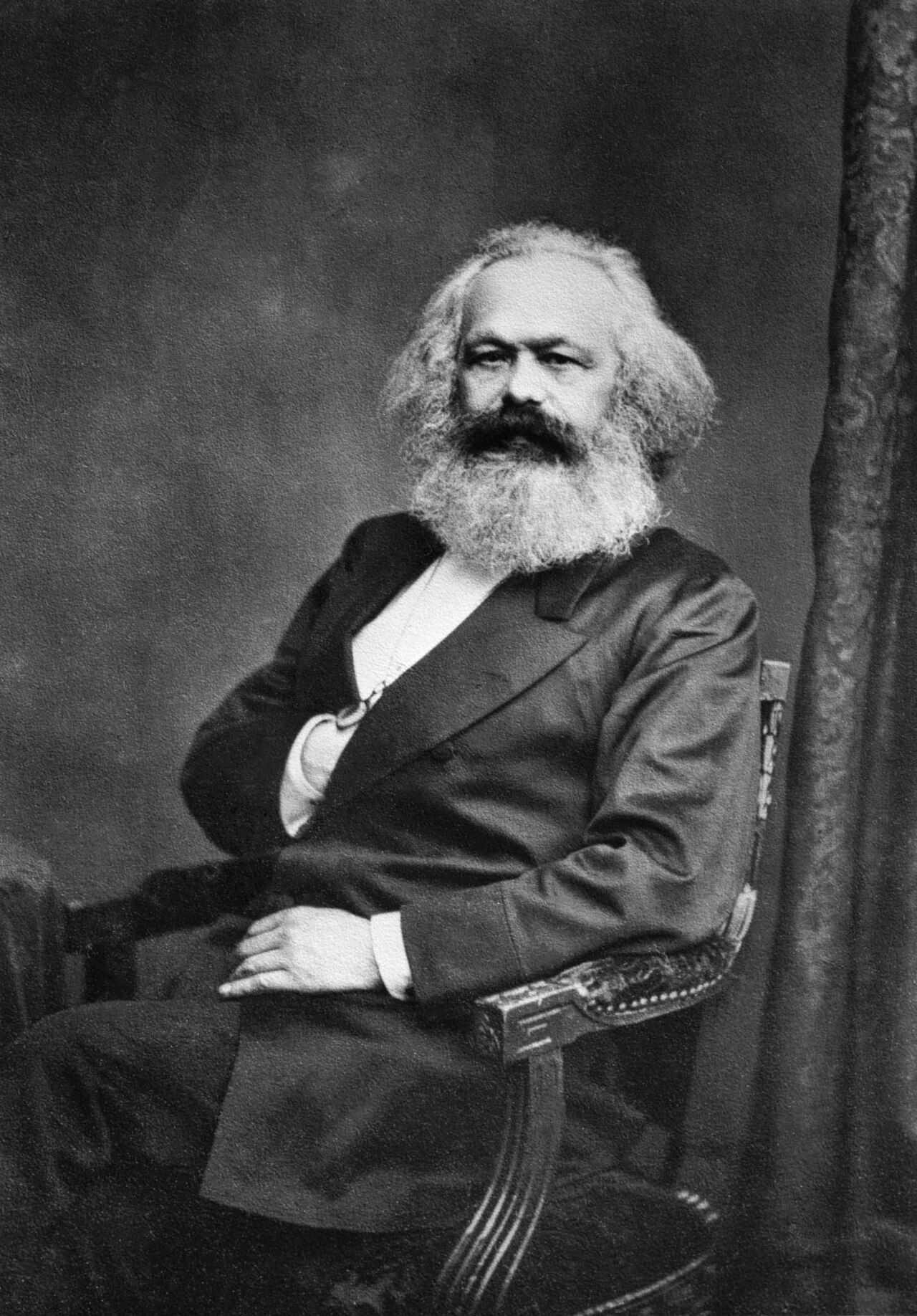
Karl Marx trained as a philosopher, with a doctorate on ancient philosophy, and began among the “Young Hegelians” who radicalised Hegel’s thought. He worked closely with Friedrich Engels, with whom he wrote The Communist Manifesto (1848).
His “historical materialism” explains the development of societies by the way they organise production, and sees history as driven by conflict between classes. His early writings describe how labour under capitalism alienates workers from what they make, from one another and from their own nature; Capital analyses how capitalism generates profit from labour. Often treated as an activist rather than a philosopher, he engaged closely with philosophers from Hegel onwards, and his ideas inspired the communist regimes of the twentieth century.
Key ideas
- Alienation
- Alienation is a problematic separation between things that belong together, such as workers and their work. Marx held that it flows from capitalist social relations, not from industry and technology, and that a classless society would be free of it.
- Historical materialism
- A society’s productive forces, its technology and labour, tend to grow more powerful over time. They explain its economic structure, which in turn explains its political and legal institutions.
- Exploitation
- Capitalism is driven by the pursuit of profit, which comes from extracting “surplus value” from workers. They are paid for less labour than they actually perform.
- Ideology
- Widely shared misunderstandings can help keep class-divided societies stable. This makes Marx, with Nietzsche and Freud, one of the “masters of suspicion” who cast doubt on how we understand ourselves and our world.
- Religion as “opium”
- Marx called religion “the opium of the people”, a harmful, illusion-generating painkiller. It arises from alienation, including the need to acknowledge our life in common, which religion does only in a distorted way.
- Tradition
- Western
- Period
- Late modern
- Themes
- How to govern
Influences
Key works
- The Communist Manifesto (Manifest der Kommunistischen Partei), 1848
- Read free at Standard Ebooks (translated by Samuel Moore)
- Capital (Das Kapital)
Sources
- Jonathan Wolff and David Leopold, Karl Marx, Stanford Encyclopedia of Philosophy