Philosopher
Jürgen Habermas
1929–2026
Also known as Jurgen Habermas
German social theorist and public intellectual who grounded morality and democracy in communication aimed at agreement, and defended the public sphere against its erosion.
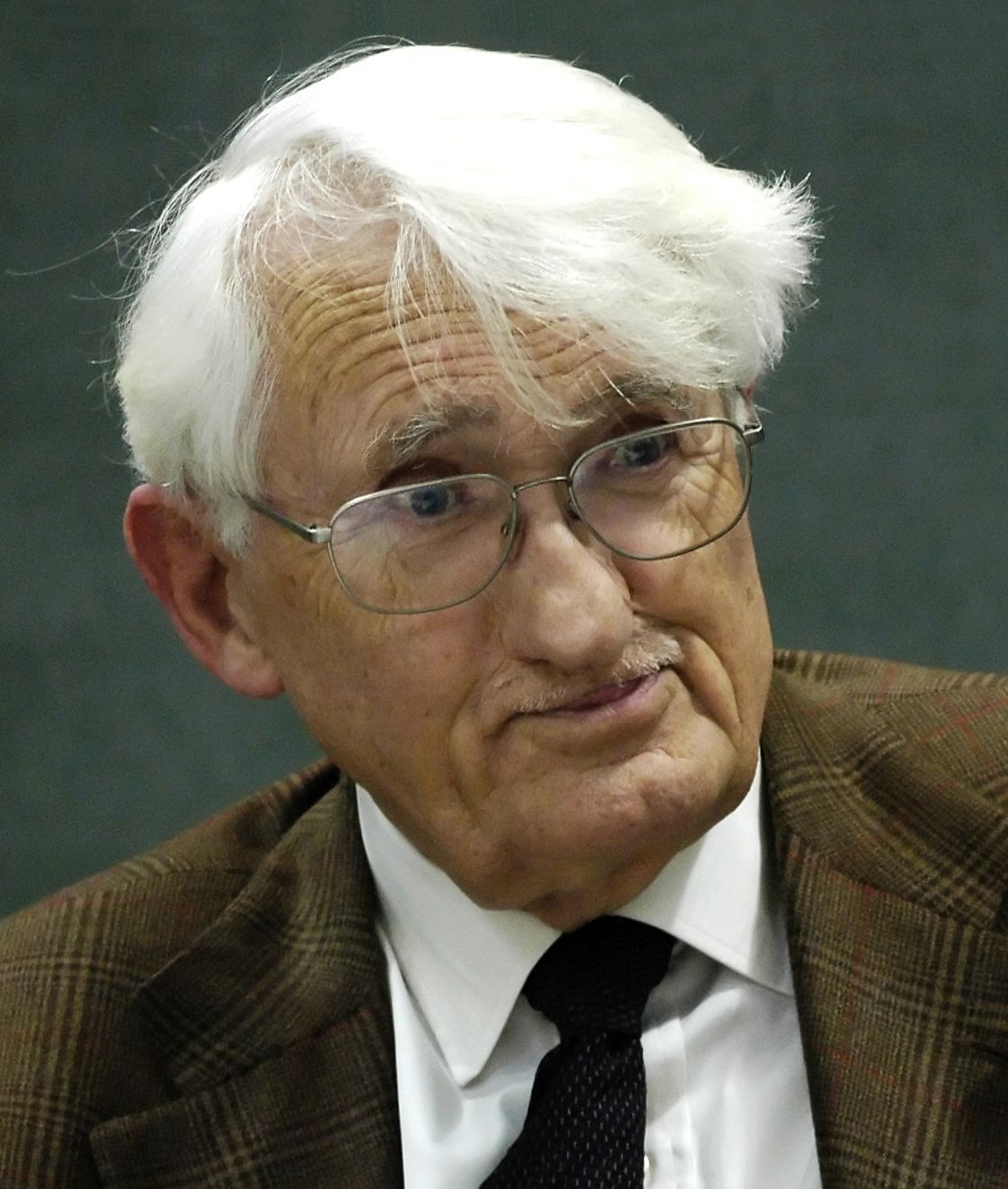

Only those norms can claim to be valid that meet (or could meet) with the approval of all in their capacity as participants in a practical discourse.
Habermas was born in 1929 and grew up in provincial North Rhine-Westphalia. As a teenager he was called up in 1944, and what he learnt of Nazi atrocities from the Nuremberg trials shook him to the core; he later called himself a product of “re-education”. As a student he publicly challenged Heidegger for refusing to retract a remark on the “inner truth and greatness” of Nazism. He was Theodor Adorno’s assistant at the Institute for Social Research, and although he is usually called the leading figure of the Frankfurt School’s second generation, he saw himself as an outsider there.
He taught at Heidelberg and Frankfurt, directed a Max Planck Institute at Starnberg, where he wrote The Theory of Communicative Action, and retired from Frankfurt in 1994. Throughout his life he was a prominent public intellectual, taking part in German debates over positivism, the uniqueness of the Holocaust, reunification, genetic engineering and religion. He died in 2026.
Key ideas
- The public sphere
- Between the state, the economy and the family lies the public sphere, where private individuals come together to reason about matters of general concern and public opinion is formed. The bourgeois public sphere of coffee houses and salons never fully realised its ideals, but they remain vital to democracy.
- Communicative action
- Habermas distinguishes action aimed at success, instrumental or strategic, from communicative action, aimed at reaching agreement on the basis of claims that can be backed by reasons.
- The colonisation of the lifeworld
- Money and administrative power can relieve society of complexity, but when they invade areas that depend on communication and consensus, the shared “lifeworld” shrinks and society is destabilised.
- Discourse ethics
- A norm is valid only if it could win the approval of all those affected, as participants in a practical discourse. This recasts Kant’s categorical imperative as a dialogue rather than a test each person carries out alone.
- Deliberative democracy
- Parliaments and courts are embedded in an informal public sphere of civil society. Democracy works when public discussion there shapes law, and in modern states the constitution, not the nation, should be the focus of citizens’ shared identity.
- Tradition
- Western
- Region
- Germany
- Schools
- Frankfurt School
- Period
- Contemporary
Influences
Influenced by
- Immanuel Kant1724–1804
- Karl Marx1818–1883criticised
- Martin Heidegger1889–1976criticised
- Theodor W. Adorno1903–1969teacher, criticised
Jürgen Habermas1929–2026
Influenced by
- Immanuel Kant1724–1804
- Karl Marx1818–1883criticised
- Martin Heidegger1889–1976criticised
- Theodor W. Adorno1903–1969teacher, criticised
Jürgen Habermas1929–2026
Where these links come from
- Jürgen Habermas drew on Immanuel Kant. Source: James Gordon Finlayson and Dafydd Huw Rees, Jürgen Habermas, Stanford Encyclopedia of Philosophy
- Jürgen Habermas drew on and argued against Karl Marx. Source: James Gordon Finlayson and Dafydd Huw Rees, Jürgen Habermas, Stanford Encyclopedia of Philosophy
- Jürgen Habermas argued against Martin Heidegger. Source: James Gordon Finlayson and Dafydd Huw Rees, Jürgen Habermas, Stanford Encyclopedia of Philosophy
- Jürgen Habermas studied with and argued against Theodor W. Adorno. Source: Henry Pickford and Lambert Zuidervaart, Theodor W. Adorno, Stanford Encyclopedia of Philosophy
Key works
- The Structural Transformation of the Public Sphere, 1962
- The Theory of Communicative Action, 1981
- Moral Consciousness and Communicative Action, 1983
- Between Facts and Norms, 1992
Sources
- James Gordon Finlayson and Dafydd Huw Rees, Jürgen Habermas, Stanford Encyclopedia of Philosophy
- Robin Celikates and Jeffrey Flynn, Critical Theory (Frankfurt School), Stanford Encyclopedia of Philosophy
- Henry Pickford and Lambert Zuidervaart, Theodor W. Adorno, Stanford Encyclopedia of Philosophy