Philosopher
Søren Kierkegaard
1813–1855
Also known as Soren Kierkegaard
Danish writer who opposed philosophical system-building, and explored faith, anxiety and what it means to exist as a single individual.
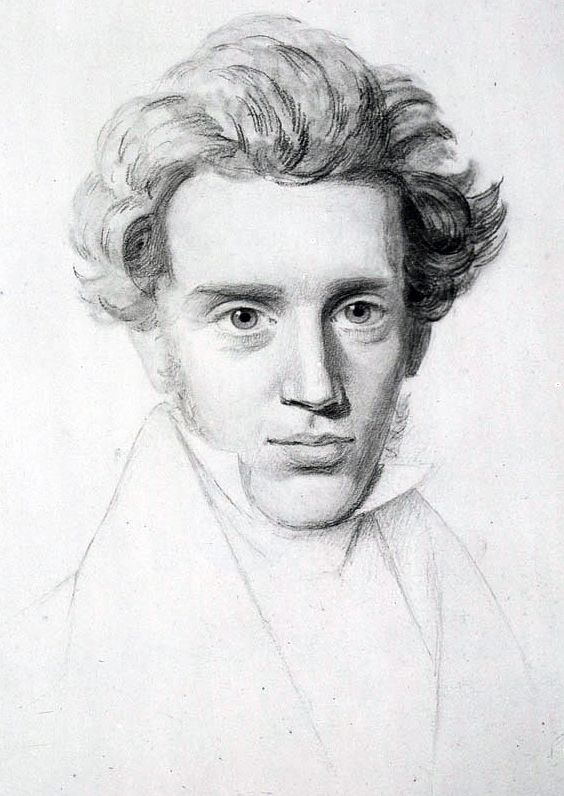
_-_(cropped).jpg)
Anxiety is the dizziness of freedom.
Søren Kierkegaard spent almost his whole life in Copenhagen and wrote nearly all of his vast output in the 1840s, much of it under pseudonyms that let him present views he did not simply share. His work spans philosophy, theology, devotional writing, literary criticism and psychology.
He opposed the system-building of Hegel and his followers, and took his model instead from Socrates. In books such as Either/Or and Fear and Trembling (both 1843) and the Concluding Unscientific Postscript (1846), he examined the choices by which an individual becomes a self, and the leap of faith that no system can make for us. He is often regarded as a forerunner of existentialism.
Key ideas
- Becoming a self
- A human self is less a thing than an achievement. The self must become what it is to become, shaping itself while accepting the limits that biology and history give it.
- Despair
- In The Sickness Unto Death, a healthy self rests on God. Most of us instead try to ground our identities in “worldly distinctions” such as riches and fame, which leaves us in despair, “the sickness unto death”.
- The spheres of existence
- Kierkegaard’s works describe different ways of living, and of failing to become a self, often grouped as the aesthetic, the ethical and the religious.
- Faith and Abraham
- Fear and Trembling explores faith through Abraham, who was willing to sacrifice his son Isaac at God’s command. Its pseudonymous author retells the story again and again, admitting he cannot understand Abraham.
- Anxiety
- “Anxiety is the dizziness of freedom”, felt when we look down into our own possibilities. For Kierkegaard, a free act can’t be explained as necessary; it always comes from a “leap”.
- Tradition
- Western
- Region
- Copenhagen
- Schools
- Existentialism
- Period
- Late modern
Influences
Influenced by
Søren Kierkegaard1813–1855
Influenced
Influenced by
Søren Kierkegaard1813–1855
Influenced
Key works
- Either/Or (Enten – Eller), 1843
- Fear and Trembling (Frygt og Bæven), 1843
- Concluding Unscientific Postscript (Afsluttende uvidenskabelig Efterskrift), 1846
Sources
- John Lippitt and C. Stephen Evans, Søren Kierkegaard, Stanford Encyclopedia of Philosophy