Philosopher
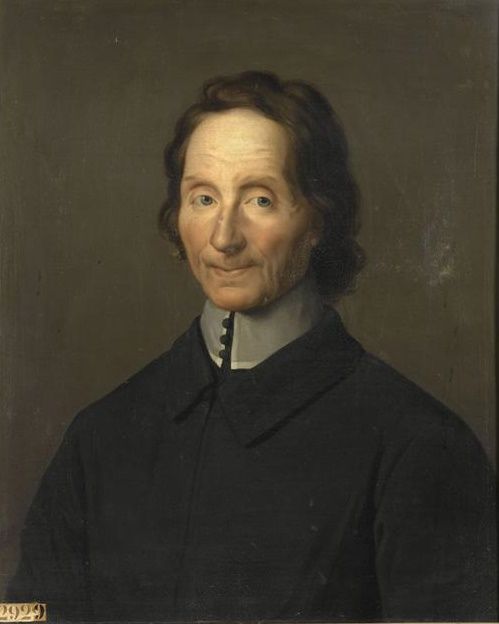
Nicolas Malebranche
1638–1715
Also known as Malebranche
French priest and Cartesian who joined Descartes to Augustine, holding that we perceive bodies by way of ideas that exist in God, and that nothing but God truly causes anything.

A true cause … is one such that the mind perceives a necessary connection between it and its effects.
Malebranche was born in Paris in 1638, a month before Louis XIV, and died there in 1715, six weeks after the king. A malformed spine and weak lungs meant he was taught at home until sixteen. He studied theology at the Sorbonne but came away disliking Aristotelian scholasticism, and in 1660 joined the Oratory, where he immersed himself in Augustine; he was ordained in 1664. That year, it is said, he came across Descartes’ Treatise on Man in a Paris bookstall and was so excited that he had to keep stopping to catch his breath. A decade of Cartesian study produced The Search after Truth (1674–75), a survey of the sources of human error and the method for avoiding them.
Pierre Bayle called him the leading philosopher of the age. His views drew long controversies, above all with the Cartesian theologian Antoine Arnauld, and Leibniz objected that occasionalism turned every event into a miracle. Hume took up and criticised elements of his thought, and Berkeley developed his own idealism partly in response to him.
Key ideas
- Vision in God
- We do not perceive bodies directly, and none of the usual accounts of ideas works. So the ideas through which we see bodies must exist in God, and we see them there.
- Occasionalism
- A true cause is one whose link to its effect the mind sees as necessary. No such link holds between bodies, or between body and mind; only an all-powerful will is necessarily followed by its effects. So God alone causes, and creatures are merely the occasions for his action.
- God acts by general laws
- God could have prevented natural evils, such as deformed births, by particular acts of will. But his wisdom shows in producing the most effects by the fewest and simplest laws, and evils follow from those laws without being willed for their own sake.
- Love in the right order
- Morality is loving things as much as they deserve. God, most perfect, is most worthy of love, people more than material things. Since the Fall, bodily pleasure disorders our love, and attending to the clear ideas in God corrects it.
- Tradition
- Western
- Region
- Paris
- Schools
- Rationalism
- Period
- Early modern
Influences
Influenced by
Nicolas Malebranche1638–1715
Influenced
Influenced by
Nicolas Malebranche1638–1715
Influenced
Where these links come from
- Nicolas Malebranche drew on Augustine. Source: Tad Schmaltz, Nicolas Malebranche, Stanford Encyclopedia of Philosophy
- Nicolas Malebranche drew on René Descartes. Source: Tad Schmaltz, Nicolas Malebranche, Stanford Encyclopedia of Philosophy
- Gottfried Wilhelm Leibniz argued against Nicolas Malebranche. Source: Tad Schmaltz, Nicolas Malebranche, Stanford Encyclopedia of Philosophy
- George Berkeley argued against Nicolas Malebranche. Source: Lisa Downing and David Hilbert, George Berkeley, Stanford Encyclopedia of Philosophy
- David Hume drew on and argued against Nicolas Malebranche. Source: Hsueh Qu and Elizabeth S. Radcliffe, David Hume, Stanford Encyclopedia of Philosophy
Key works
- The Search after Truth (De la recherche de la vérité)
- Treatise on Nature and Grace (Traité de la nature et de la grâce)
- Dialogues on Metaphysics and on Religion (Entretiens sur la métaphysique et sur la religion)
- Treatise on Ethics (Traité de morale)
Sources
- Tad Schmaltz, Nicolas Malebranche, Stanford Encyclopedia of Philosophy