Philosopher
Gottfried Wilhelm Leibniz
1646–1716
Rationalist polymath who co-invented the calculus and argued that the world consists of simple substances, monads, and is the best of all possible worlds.
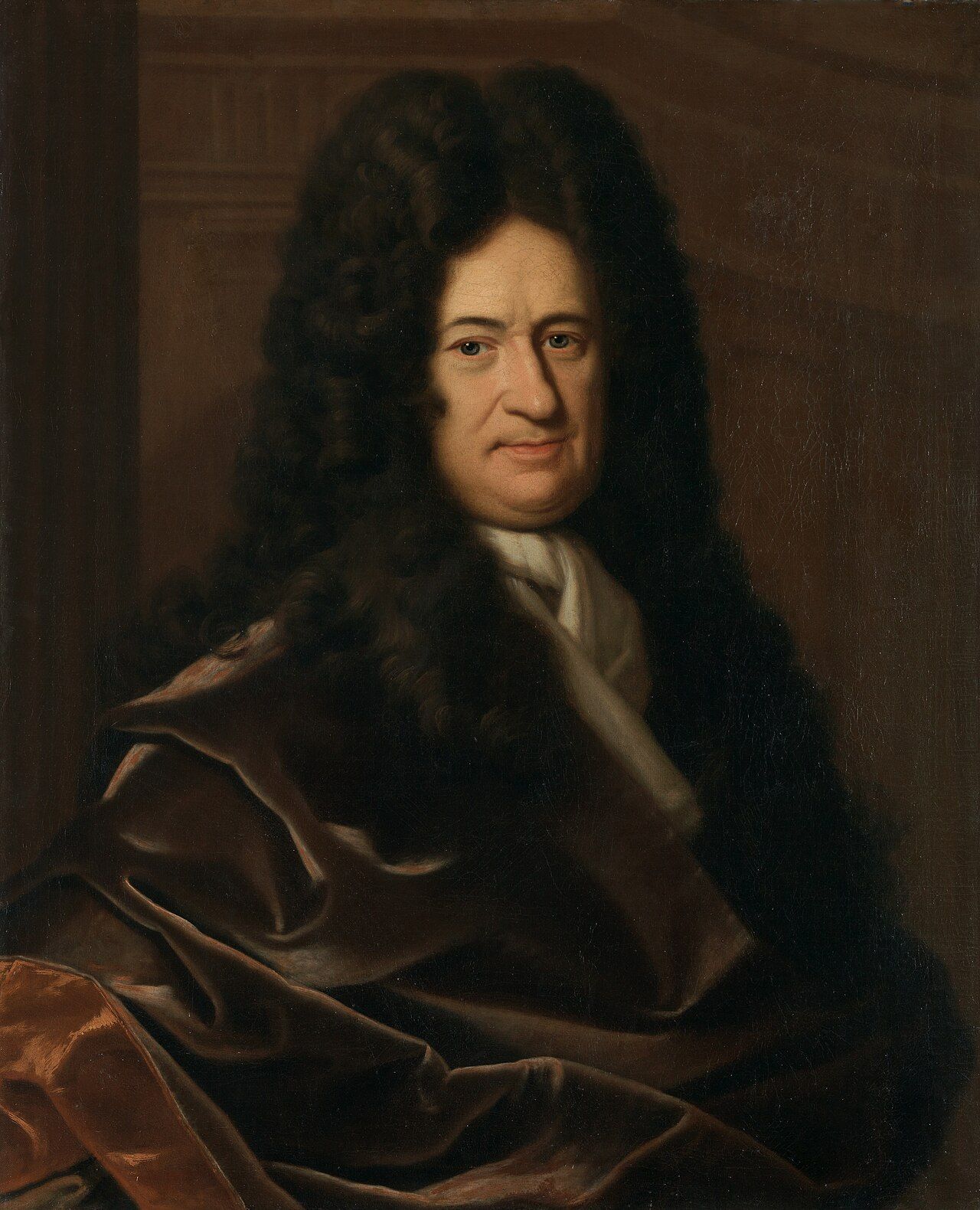
.jpg)
The Monads have no windows, through which anything could come in or go out.
Gottfried Wilhelm Leibniz spent most of his career in the service of the dukes of Hanover, as librarian, historian and diplomat, while making deep contributions to metaphysics, logic, mathematics and physics. He developed the calculus independently of Isaac Newton, which led to a bitter dispute over who had discovered it first.
In metaphysics he argued that the world is made up of simple, soul-like substances, “monads”, each reflecting the whole universe from its own point of view, and that God, being perfectly good and wise, created the best of all possible worlds. Much of his philosophy survives in letters and short essays rather than long treatises.
Key ideas
- The best of all possible worlds
- God is perfect in power, knowledge and wisdom, so God always acts for the best. In answer to the problem of evil, Leibniz concluded that we live in the best of all possible worlds, a thesis Voltaire mocked in Candide.
- The principle of sufficient reason
- Nothing is without a reason, so there is always a reason why things are so and not otherwise, even if “most of the time these reasons cannot be known to us”. Leibniz called it one of the most fruitful principles of all human knowledge.
- The identity of indiscernibles
- No two substances can be exactly alike and differ only in number. If two things share all their properties, they are one and the same thing.
- Monads
- The only genuine substances are monads, simple mind-like beings endowed with perception and appetite. Bodies and motion are not eliminated but result from these simple substances and their perceptions.
- Pre-established harmony
- Mind and body don’t act on each other. Like two pendulums swinging in time, God created them so that each follows its own nature in perfect agreement with the other.
- Tradition
- Western
- Region
- Hanover
- Schools
- Rationalism
- Period
- Early modern
Influences
Influenced by
Gottfried Wilhelm Leibniz1646–1716
Influenced
Influenced by
Gottfried Wilhelm Leibniz1646–1716
Influenced
Key works
- Discourse on Metaphysics (Discours de métaphysique), 1686
- Read free at Wikisource (translated by George R. Montgomery)
- Theodicy (Essais de Théodicée), 1710
- Monadology, 1714
- Read free at Wikisource (translated by Robert Latta)
Sources
- Brandon C. Look, Gottfried Wilhelm Leibniz, Stanford Encyclopedia of Philosophy