Philosopher
Lucretius
c. 95 – c. 55 BCE
Also known as Titus Lucretius Carus
Roman poet whose _On the Nature of Things_ set out Epicurus' atomism in Latin verse, to free readers from fear of the gods and of death.
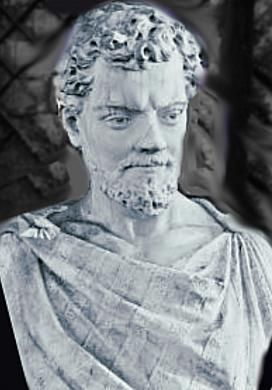

Therefore death to us / Is nothing, nor concerns us in the least, / Since nature of mind is mortal evermore.
Such are the crimes to which Religion leads.
Almost nothing is known of Lucretius’ life beyond what his poem suggests. The only contemporary mention is a letter of Cicero from February 54 BCE, praising the poem’s brilliance and skill; later reports put his birth in the mid-90s BCE and his death in the mid-50s. Jerome’s story that a love potion drove him mad, and that he wrote in the intervals of sanity before killing himself, is not to be trusted. The poem is dedicated to Memmius, probably a Roman politician of the 50s.
On the Nature of Things is a didactic poem in six books, turning Epicurus’ Greek prose into Latin hexameters, and it is the fullest surviving account of Epicurean physics; it is our only Epicurean source for the swerve. Lucretius presents himself as Epicurus’ devoted follower and as a Roman Empedocles, praising the Sicilian poet while rejecting his four elements. Virgil and other Roman poets admired him. Lost for centuries, the poem was rediscovered in 1417 and went on to help shape early modern science and moral thought; Montaigne mined it for arguments.
Key ideas
- Atoms and void
- Nothing comes from nothing, and nothing is destroyed into nothing. Everything is made of atoms moving endlessly through empty space, as dust drifts in a beam of sunlight, and atoms in themselves have no colour or other qualities we perceive.
- The swerve
- Atoms falling through the void sometimes deviate by the smallest amount, at no fixed time or place. Without this swerve they would never collide to form things, and our will would be caught in an endless chain of causes.
- Death is nothing to us
- The soul is made of fine atoms and is part of the body, so it cannot survive death; he gives some thirty proofs. Since after death there is no one left to suffer, death is not to be feared, any more than the time before we were born.
- A world without design
- The gods live in perfect peace, far from our affairs, and neither made the world nor intervene in it. Organs and animals were not designed for a purpose, and early humans, seeing gods in dreams and unable to explain the heavens, handed the running of the world over to them.
- Tradition
- Western
- Region
- Rome
- Schools
- Epicureanism
- Period
- Ancient Greek and Roman
Influences
Influenced by
Lucretiusc. 95 – c. 55 BCE
Influenced
Influenced by
Lucretiusc. 95 – c. 55 BCE
Influenced
Where these links come from
- Lucretius drew on and argued against Empedocles. Source: Simon Trépanier, Lucretius, Stanford Encyclopedia of Philosophy
- Lucretius drew on Epicurus. Source: Simon Trépanier, Lucretius, Stanford Encyclopedia of Philosophy
- Michel de Montaigne drew on Lucretius. Source: Marc Foglia and Emiliano Ferrari, Michel de Montaigne, Stanford Encyclopedia of Philosophy
- Giordano Bruno drew on Lucretius. Source: Dilwyn Knox, Giordano Bruno, Stanford Encyclopedia of Philosophy
Key works
- On the Nature of Things (De rerum natura)
- Read free at Project Gutenberg (translated by William Ellery Leonard)
Sources
- Simon Trépanier, Lucretius, Stanford Encyclopedia of Philosophy