Philosopher
Empedocles
fl. 470–430 BCE
Also known as Empedocles of Acragas, Empedokles
Sicilian poet-philosopher who explained all change as the mixing and separating of four eternal roots, earth, water, air and fire, by two forces, Love and Strife.

For I have been ere now a boy and a girl, a bush and a bird and a dumb fish in the sea.
There is no coming into being of aught that perishes, nor any end for it in baneful death; but only mingling and change of what has been mingled.
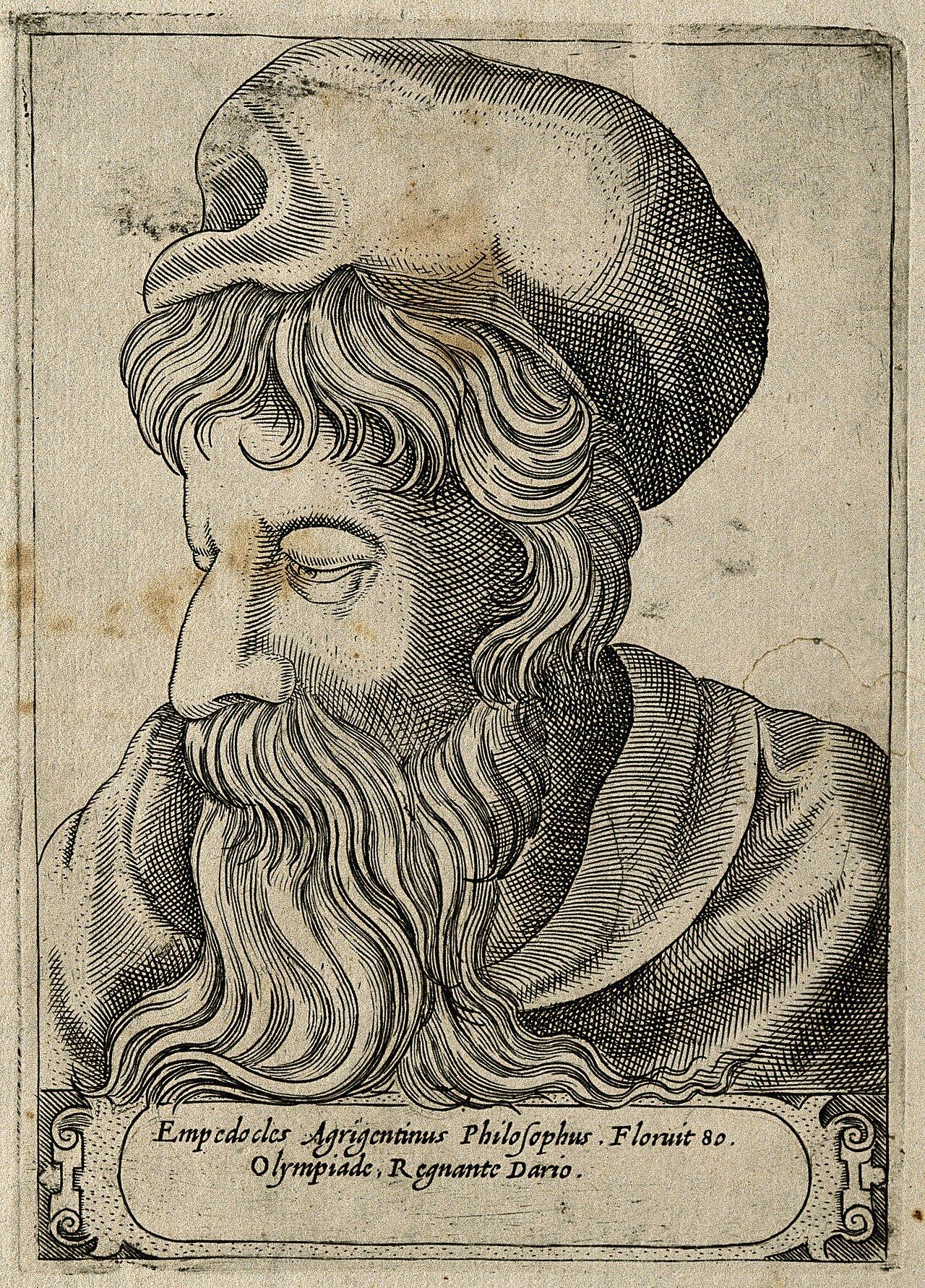
Empedocles came from Acragas, the modern Agrigento, on the south coast of Sicily, probably from an aristocratic family, and was born early in the fifth century BCE; Aristotle says he died at sixty. Ancient biographers told colourful stories about him, many of them drawn from his own verses: that he championed the people against would-be tyrants, refused a crown, practised medicine and even raised a dead woman to life. The famous tale that he died by leaping into Etna is certainly false. He wrote in hexameter verse, and more of his lines survive than of any other Presocratic.
His philosophy answers Parmenides’ argument that nothing can come to be or pass away: the four roots and the two forces are eternal, and only their combinations change. Two poems are traditionally named, On Nature and Purifications, and scholars disagree about how many poems there were and how the physics fits with his teaching on the wandering spirit and purification, which draws on Orphic and Pythagorean beliefs. Plato mentions him often, Aristotle discusses him more than any philosopher other than Plato, and Lucretius praised him warmly.
Key ideas
- Four roots
- Everything is made of four eternal roots, fire, air, water and earth, which he named after gods. Nothing truly comes into being or perishes; what we call birth and death is only the mixing of the roots and their separation.
- Love and Strife
- Two opposed forces move the roots. Love draws unlike roots together into harmony, and Strife pulls them apart so that like gathers with like. Their power waxes and wanes, so that at one extreme all is mixed into a single Sphere and at the other all is separated.
- Like perceives like
- We perceive earth with the earth in us, water with water, and so on. Everything gives off fine streams of particles, which enter the pores of the sense organs, and thinking is done chiefly by the blood around the heart.
- The exiled spirit
- A divine spirit that stains itself with bloodshed is banished from the gods and must pass through many lives as plants, animals and people. Since any creature might house such a spirit, killing animals and eating meat are forbidden.
- Tradition
- Western
- Region
- Acragas (Agrigento), Sicily
- Period
- Ancient Greek and Roman
- Themes
- What is ultimately real
Influences
Influenced by
Empedoclesfl. 470–430 BCE
Influenced
Influenced by
Empedoclesfl. 470–430 BCE
Influenced
Where these links come from
- Empedocles drew on Pythagoras. Source: K. Scarlett Kingsley and Richard Parry, Empedocles, Stanford Encyclopedia of Philosophy
- Empedocles drew on and argued against Parmenides. Source: K. Scarlett Kingsley and Richard Parry, Empedocles, Stanford Encyclopedia of Philosophy
- Aristotle drew on and argued against Empedocles. Source: K. Scarlett Kingsley and Richard Parry, Empedocles, Stanford Encyclopedia of Philosophy
- Lucretius drew on and argued against Empedocles. Source: Simon Trépanier, Lucretius, Stanford Encyclopedia of Philosophy
Key works
- On Nature
- Purifications
Sources
- K. Scarlett Kingsley and Richard Parry, Empedocles, Stanford Encyclopedia of Philosophy