Philosopher
Giordano Bruno
1548–1600
Also known as Filippo Bruno, Il Nolano
Renaissance philosopher who took Copernicus as proof of an infinite, living universe full of other worlds, in which God is present in all things. He was burned as a heretic in Rome.
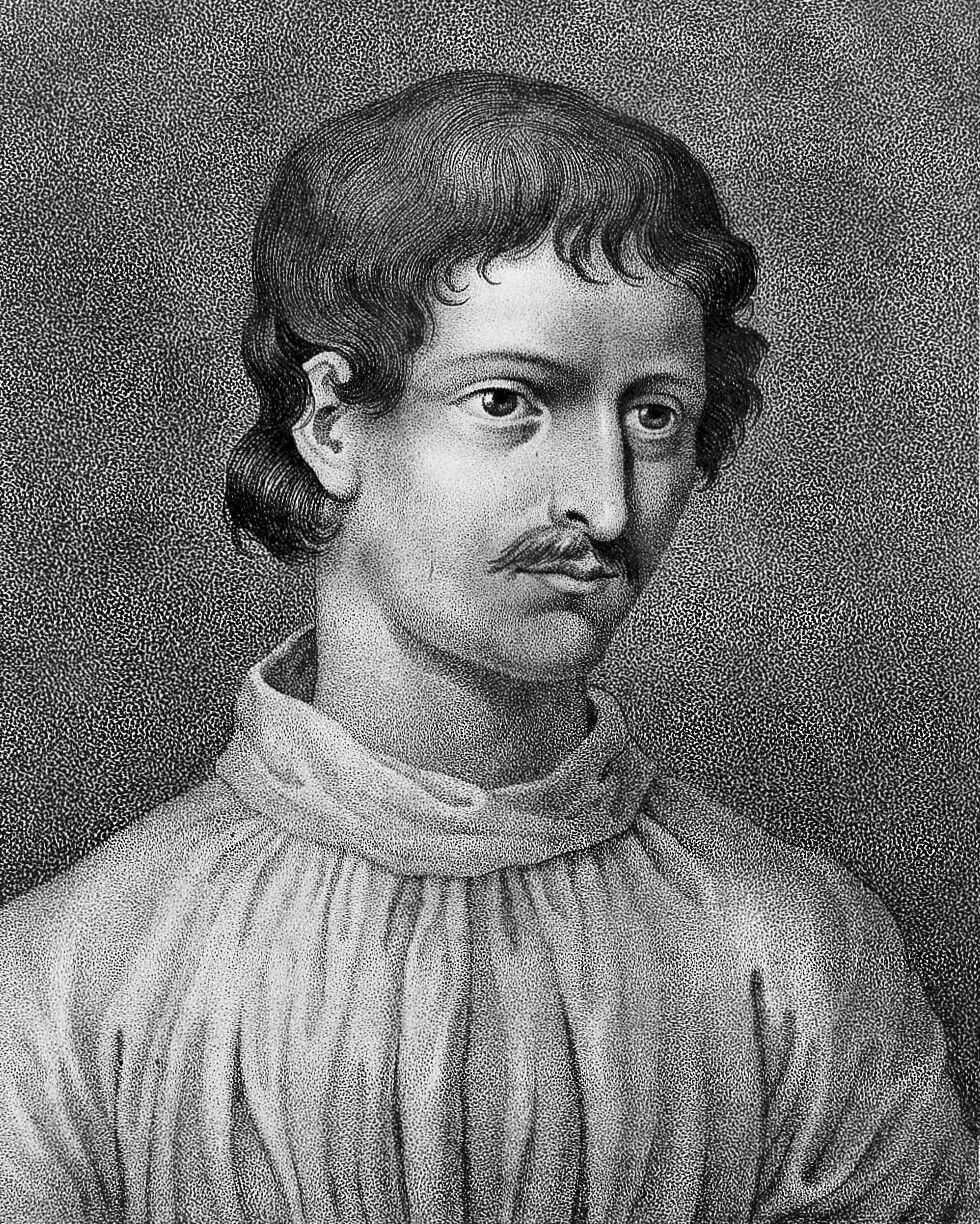
.jpg)
Filippo Bruno was born in 1548 at Nola, near Naples, the son of a soldier. At seventeen he entered the Dominican house in Naples, taking the name Giordano, and was ordained in 1572, but he was soon suspected of heresy and in 1576 fled the order. For fifteen years he wandered through Italy, France, Switzerland, England, Germany and Bohemia, living by teaching and writing; he was excommunicated by Catholics, Calvinists and Lutherans alike. In London he published his Italian dialogues, beginning with The Ash Wednesday Supper (1584), in which he mocked the learning of Oxford.
In 1591 he returned to Italy. A Venetian patron denounced him to the Inquisition, and he was sent to Rome, where his trial lasted seven years. When he refused to recant, he was burned alive in the Campo de’ Fiori on 17 February 1600, and his works were placed on the Index. Condemned as an atheist in the next century, he was rediscovered in the late eighteenth century as a forerunner of Spinoza’s monism, and Schelling named a dialogue after him.
Key ideas
- An infinite universe of worlds
- Copernicus had shown that the earth is a planet circling the sun, and with it fell Aristotle’s natural places and his sphere of unchanging heavens. The universe is therefore infinite and eternal, and filled with countless solar systems like our own.
- The universe as one being
- Taking up the monism of the Eleatics, he held that the universe is a single, living whole that never changes in essence, while finite things are only its passing “accidents” or modes, like the shifting shapes of one creature.
- God in things
- The infinite universe is the image and expression of God’s infinite power. God unfolds himself as a world soul and a universal matter, and nature is “God in things”, though God also remains hidden beyond them.
- Everything has a soul
- The world soul is present everywhere, so all things are alive and ensouled in some degree. Souls are immortal, and so that conduct could still be rewarded or punished he revived the ancient idea that they pass into new bodies.
- Philosophy as salvation
- Rejecting the Christian emphasis on human weakness, he urged people to perfect their intellects. For him philosophy, not revealed religion, was the true source of healing, and he mocked Christianity’s praise of ignorance.
- Tradition
- Western
- Region
- Nola, near Naples; France, England and Germany; Rome
Influences
Influenced by
- Parmenidesfl. 500–450 BCE
- Aristotle384–322 BCEcriticised
- Lucretiusc. 95 – c. 55 BCE
- Plotinusc. 204 – 270 CE
- Nicholas of Cusa1401–1464
Giordano Bruno1548–1600
Influenced by
- Parmenidesfl. 500–450 BCE
- Aristotle384–322 BCEcriticised
- Lucretiusc. 95 – c. 55 BCE
- Plotinusc. 204 – 270 CE
- Nicholas of Cusa1401–1464
Giordano Bruno1548–1600
Where these links come from
- Giordano Bruno drew on Parmenides. Source: Dilwyn Knox, Giordano Bruno, Stanford Encyclopedia of Philosophy
- Giordano Bruno argued against Aristotle. Source: Dilwyn Knox, Giordano Bruno, Stanford Encyclopedia of Philosophy
- Giordano Bruno drew on Lucretius. Source: Dilwyn Knox, Giordano Bruno, Stanford Encyclopedia of Philosophy
- Giordano Bruno drew on Plotinus. Source: Dilwyn Knox, Giordano Bruno, Stanford Encyclopedia of Philosophy
- Giordano Bruno drew on Nicholas of Cusa. Source: Dilwyn Knox, Giordano Bruno, Stanford Encyclopedia of Philosophy
Key works
- The Ash Wednesday Supper (La cena de le ceneri)
- On the Cause, the Principle and the One (De la causa, principio et uno)
- On the Infinite Universe and Worlds (De l'infinito, universo e mondi)
- The Heroic Frenzies (De gli eroici furori)
- On the Immense (De immenso)
Sources
- Dilwyn Knox, Giordano Bruno, Stanford Encyclopedia of Philosophy