Philosopher
Jean-Jacques Rousseau
1712–1778
Genevan thinker who argued that society corrupts naturally good human beings, and that legitimate law must express the general will of free and equal citizens.
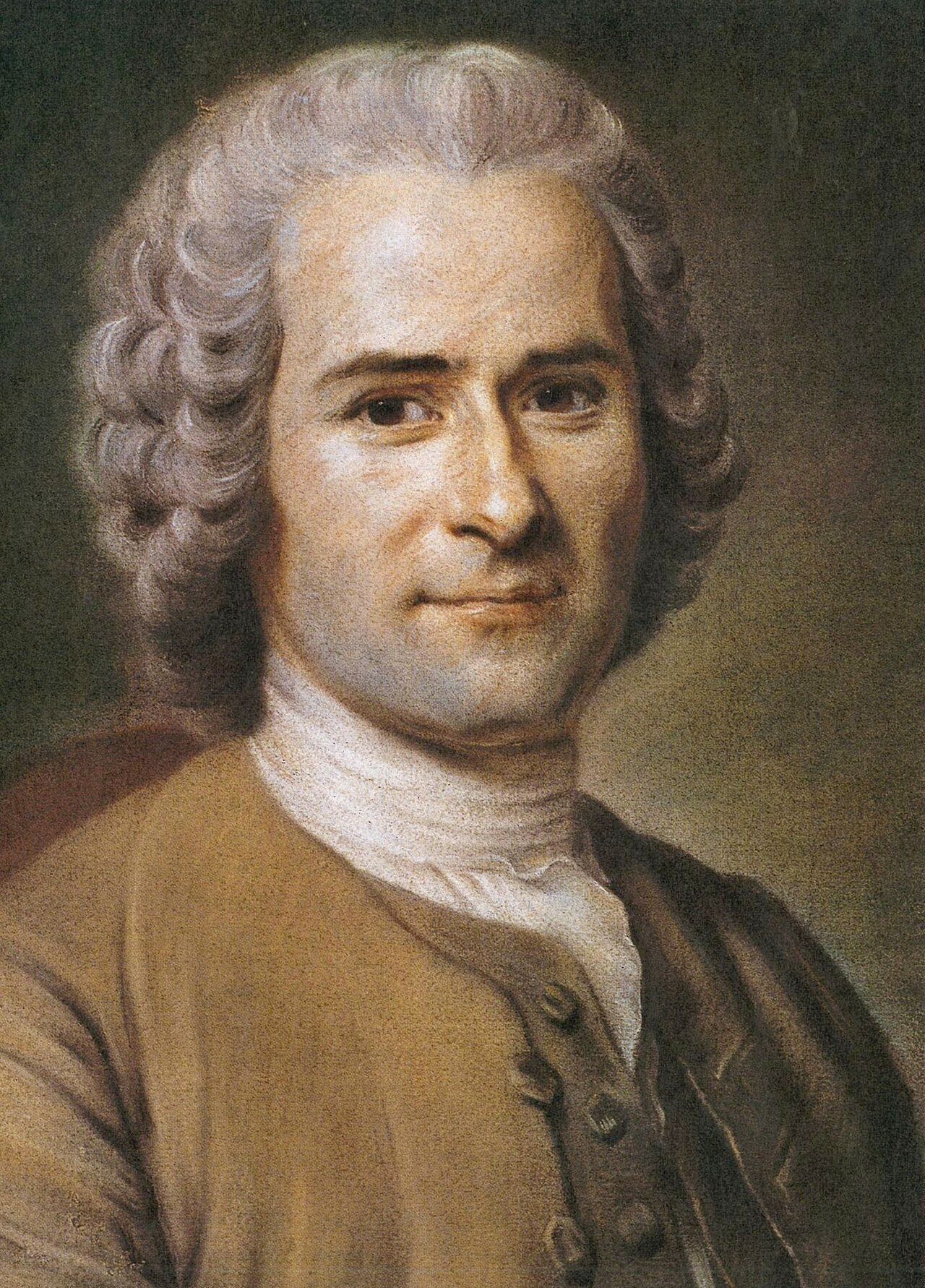
.jpg)
Man is born free; and everywhere he is in chains.
Jean-Jacques Rousseau was born in Geneva in 1712 and made his name with an essay arguing that the progress of the arts and sciences had corrupted morals. In his Discourse on the Origin of Inequality he told a conjectural history of how human beings, naturally moved by compassion, came to depend on one another’s good opinion and to accept unjust social arrangements.
In The Social Contract (1762) he asked how people can live under laws and yet remain free, answering that legitimate law must express the “general will” of a community of equal citizens. His ideas influenced the French Revolution, which moved his remains to the Panthéon, and thinkers from Kant onwards.
Key ideas
- Natural goodness
- Rousseau said the single idea at the centre of his thought was that human beings are good by nature but corrupted by society. The “goodness” in question isn’t moral goodness, which Rousseau didn’t think natural.
- Amour propre
- In society, simple self-love (amour de soi) is joined by amour propre, a drive to be recognised and respected by others. It makes our worth depend on how we compare with other people.
- The general will
- “Man is born free, but is everywhere in chains.” In The Social Contract, Rousseau claimed to reconcile freedom with authority: by obeying the general will, citizens obey a will that is also their own.
- Natural education
- In Emile, education should follow the development of the child’s natural capacities. The tutor arranges the child’s surroundings so that the child learns through its own discovery rather than by being told.
- Tradition
- Western
- Region
- Geneva and France
- Schools
- Social contract theory
- Period
- Early modern
- Themes
- How to govern
Influences
Influenced by
Jean-Jacques Rousseau1712–1778
Influenced
Influenced by
Jean-Jacques Rousseau1712–1778
Influenced
Key works
- Discourse on the Origin of Inequality (Discours sur l’origine de l’inégalité), 1755
- Read free at Project Gutenberg (Harvard Classics edition)
- The Social Contract (Du contrat social), 1762
- Emile (Émile, ou De l’éducation), 1762
Sources
- Christopher Bertram, Jean Jacques Rousseau, Stanford Encyclopedia of Philosophy