Philosopher
Bonaventure
c. 1221 – 1274
Also known as Bonaventure of Bagnoregio, Saint Bonaventure, Bonaventura
Franciscan master at Paris and head of his order, who read the whole of creation as signs leading the mind to God, and argued that a created world cannot be eternal.
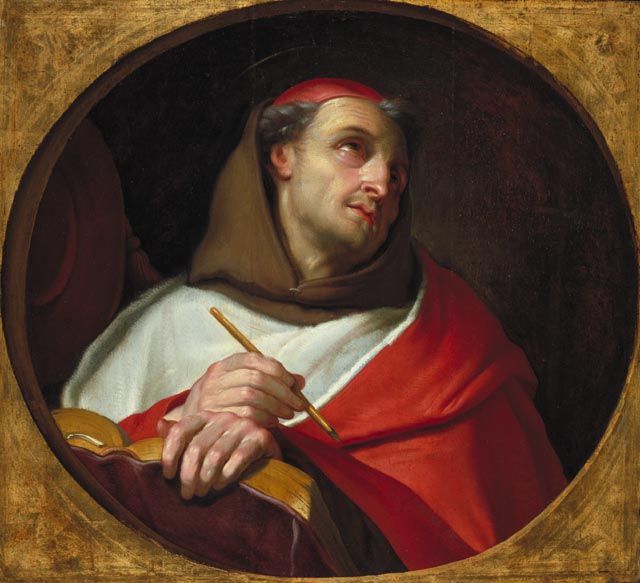
_-_Saint_Bonaventure.jpg)
For I do not intend to advocate new opinions, but to reweave the common and approved ones.
Bonaventure was born around 1221 in Bagnoregio in central Italy; he later wrote that as a boy he had been saved from death through the intercession of Francis of Assisi. He went to Paris in about 1235, studied philosophy there until 1243, and joined the Franciscans. He then studied theology under the order’s masters, lectured on Peter Lombard’s Sentences, and became a master of theology. In 1257 he was elected Minister General of the Franciscans, which he led for seventeen years; he was made a cardinal in 1273 and died at the Second Council of Lyon in 1274.
All his philosophy lies inside works of theology, sermons and spiritual guidance, and he wrote no commentaries on Aristotle. He took broadly Aristotelian principles from his teachers but drew his own conclusions, often Augustinian ones, and Augustine was his favourite authority. Scholars have long compared him with his contemporary Thomas Aquinas, and he was the first thinker of the thirteenth century to take Anselm’s ontological argument seriously.
Key ideas
- Creatures as signs of God
- Every creature points to God. All things, from rocks to angels, are shadows and footprints of their maker, while rational creatures are also images of God, and likenesses of him when grace conforms them to his will. The Journey of the Mind into God climbs through these signs.
- The world had a beginning
- Aristotle probably did teach that the world has always existed. But a world that is both eternal and created from nothing is a contradiction, so reason itself shows that a created world must have had a first moment.
- Truth leads to God
- Following Augustine, every true statement posits truth, and so posits the truth that causes all truth, which is God. Bonaventure recast Augustine’s inward path to God as plain syllogisms, holding that knowledge depends on both divine light and our own powers.
- We cannot fail to know God exists
- Reading Anselm, he held that God’s existence is known to everyone, like a basic axiom of thought. People can still argue themselves into atheism because their idea of what God is is faulty, a defect that faith and reason can remedy.
- Tradition
- Western
- Region
- Bagnoregio, Italy; Paris
- Schools
- Scholasticism
- Period
- Medieval
Influences
Influenced by
- Aristotle384–322 BCEcriticised
- Augustine354–430 CE
- Avicennac. 970 – 1037 CE
- Anselm of Canterbury1033–1109
Bonaventurec. 1221 – 1274
Influenced by
- Aristotle384–322 BCEcriticised
- Augustine354–430 CE
- Avicennac. 970 – 1037 CE
- Anselm of Canterbury1033–1109
Bonaventurec. 1221 – 1274
Where these links come from
- Bonaventure drew on and argued against Aristotle. Source: Tim Noone, R. E. Houser and Joshua Benson, Bonaventure, Stanford Encyclopedia of Philosophy
- Bonaventure drew on Augustine. Source: Tim Noone, R. E. Houser and Joshua Benson, Bonaventure, Stanford Encyclopedia of Philosophy
- Bonaventure drew on Avicenna. Source: Tim Noone, R. E. Houser and Joshua Benson, Bonaventure, Stanford Encyclopedia of Philosophy
- Bonaventure drew on Anselm of Canterbury. Source: Tim Noone, R. E. Houser and Joshua Benson, Bonaventure, Stanford Encyclopedia of Philosophy
Key works
- The Journey of the Mind into God (Itinerarium mentis in Deum)
- Commentary on the Sentences
- Collations on the Hexaemeron (Collationes in Hexaëmeron)
Sources
- Tim Noone, R. E. Houser and Joshua Benson, Bonaventure, Stanford Encyclopedia of Philosophy