Philosopher
John Duns Scotus
c. 1265 – 1308
Also known as Duns Scotus, Scotus, the Subtle Doctor
Franciscan philosopher-theologian, "the Subtle Doctor", known for the univocity of being, the "thisness" that makes each thing an individual, and a will free at the very moment of choice.
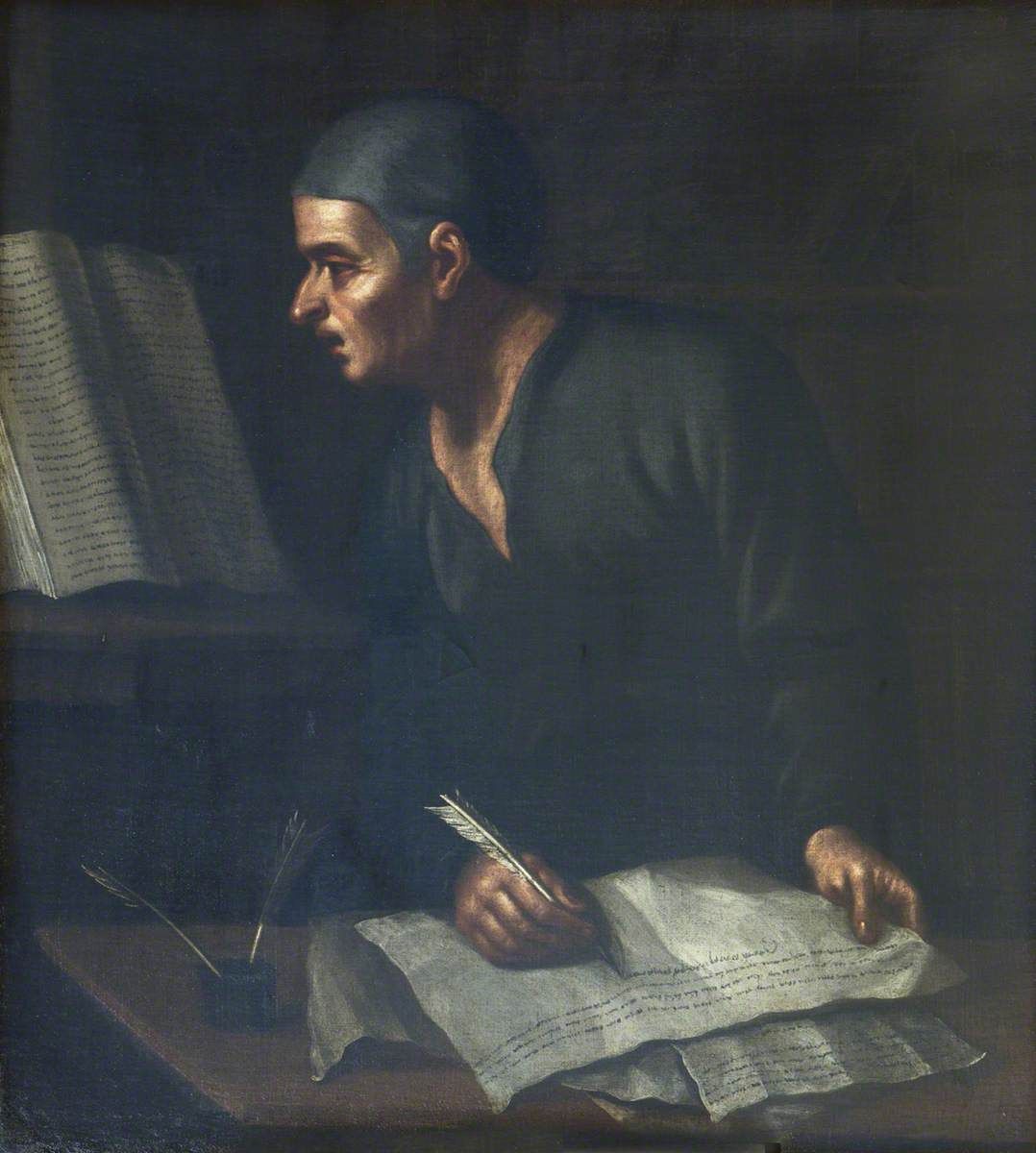
_(attributed_to)_-_Duns_Scotus_-_MCPo-38_-_Merton_College.jpg)
John Duns was born in the Scottish village of Duns, near the English border; “Scotus” simply marks him as a Scot. The traditional birth year is 1265–6, but his ordination records suggest he was a little older. A Franciscan, he studied and taught at Cambridge, Paris and Oxford, where he lectured on Peter Lombard’s Sentences, the standard theology textbook, and he spent the rest of his life revising those lectures into the unfinished Ordinatio.
In 1303 he was expelled from France for siding with the pope against King Philip IV, but returned to become the Franciscan master of theology at Paris. He was sent to Cologne in 1307 and died there on 8 November 1308. His subtle and complex thought, which earned him the title “the Subtle Doctor”, left its mark on debates about religious language, universals, knowledge and human freedom.
Key ideas
- The univocity of being
- Against Aquinas, some words, such as “being”, can be applied to God and creatures with exactly the same meaning. Otherwise, since all our concepts come from creatures, we could not talk about God at all.
- Common nature and “thisness”
- Humanity is really common to Socrates and Plato, but in each it is made individual by a “thisness” (haecceitas) of its own. Scotus was a realist about universals, and this was his answer to what makes an individual this one.
- God as infinite being
- Scotus’s proof of God’s existence argues to a first cause that is infinite. Infinity is the key to his concept of God, from which the other divine attributes follow.
- Freedom in the will
- For a choice to be free, the agent must be able to will otherwise at the very moment of choosing. Freedom belongs to the will in its own right, not, as Aquinas held, to the will because of reason.
- Knowledge without special illumination
- The human intellect can reach certain knowledge by its own natural powers. Against both sceptics and those who held that certainty needs divine illumination, Scotus defended the reliability of our natural cognition.
- Tradition
- Western
- Region
- Oxford, Paris and Cologne
- Schools
- Scholasticism
- Period
- Medieval
Influences
Influenced by
John Duns Scotusc. 1265 – 1308
Influenced
Influenced by
John Duns Scotusc. 1265 – 1308
Influenced
Where these links come from
- John Duns Scotus drew on Aristotle. Source: Thomas Williams, John Duns Scotus, Stanford Encyclopedia of Philosophy
- John Duns Scotus drew on Anselm of Canterbury. Source: Thomas Williams, John Duns Scotus, Stanford Encyclopedia of Philosophy
- John Duns Scotus drew on and argued against Thomas Aquinas. Source: Thomas Williams, John Duns Scotus, Stanford Encyclopedia of Philosophy
- William of Ockham argued against John Duns Scotus. Source: Paul Vincent Spade, Claude Panaccio and Jenny Pelletier, William of Ockham, Stanford Encyclopedia of Philosophy
- Hasdai Crescas drew on John Duns Scotus. Source: Shalom Sadik, Hasdai Crescas, Stanford Encyclopedia of Philosophy
- Charles Sanders Peirce drew on John Duns Scotus. Source: Robert Burch, Charles Sanders Peirce, Stanford Encyclopedia of Philosophy
Key works
- Ordinatio
- Treatise on the First Principle (De primo principio)
- Questions on Aristotle's Metaphysics (Quaestiones super libros Metaphysicorum Aristotelis)
Sources
- Thomas Williams, John Duns Scotus, Stanford Encyclopedia of Philosophy