Philosopher
Śāntarakṣita
c. 725 – c. 788 CE
Also known as Shantarakshita, Santaraksita
Buddhist philosopher who joined Madhyamaka, Yogācāra and the logic of Dharmakīrti into one system, then took it to Tibet as the first abbot of Samye.
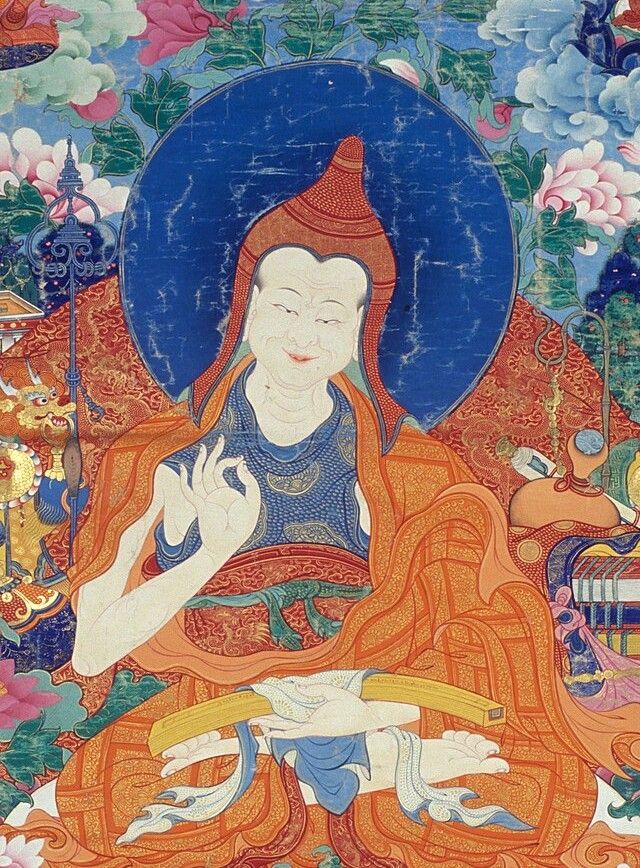

By relying on the Mind-Only system, know that external entities do not exist. And by relying on this [Middle Way] system, know that no self exists at all, even in that [mind].
Śāntarakṣita was one of the last great Indian interpreters of Nāgārjuna’s Madhyamaka, and a commentator on Dharmakīrti in equal measure. His synthesis of Madhyamaka, the Yogācāra or Mind-only school, and the logic and epistemology of Dignāga and Dharmakīrti is often described as Indian Buddhist philosophy’s final great innovation. His encyclopedic Compendium of Reality examines the views of many rival schools, and engages at length with the Mīmāṃsā philosopher Kumārila.
He travelled to Tibet twice and lived there for his final fifteen years. He founded Samye, the first Buddhist monastery in Tibet, served as its first abbot, ordained the first seven Tibetan monks, and set up a programme of philosophical study modelled on the Indian monastic universities. In effect, he and his student Kamalaśīla taught Tibetans how to do philosophy.
Key ideas
- Neither one nor many
- Nothing has an inherent nature, because nothing is truly single, having parts or relations to many things, and nothing is truly manifold, since a many would be made of true units. There is no third option, so all things are empty.
- Authentic conventional truth
- Things that cannot withstand analysis still exist conventionally. The authentic conventional things are those that are known by a mind, arise and perish, and can do something; they are not mere words.
- Mind-only as a step to the Middle Way
- Relying on the Mind-only (Yogācāra) view, we see that there are no external objects; relying on the Middle Way (Madhyamaka), we see that even the mind has no self. Śāntarakṣita made the first a stage on the way to the second.
- A ladder of views
- His Ornament of the Middle Way takes the reader up a hierarchy of positions, arguing first as one school would against another, so that each view is provisionally adopted and then surpassed, until the reader reaches the Madhyamaka.
- Tradition
- Indian
- Region
- India and Tibet
- Schools
- Madhyamaka
- Themes
- What is ultimately real
Influences
Influenced by
- Nāgārjunafl. 150–250 CE
- Gauḍapādafl. 450–550 CE
- Dharmakīrtic. 600 – c. 660 CE
- Kumārila Bhaṭṭafl. 640–680 CEcriticised
Śāntarakṣitac. 725 – c. 788 CE
Influenced by
- Nāgārjunafl. 150–250 CE
- Gauḍapādafl. 450–550 CE
- Dharmakīrtic. 600 – c. 660 CE
- Kumārila Bhaṭṭafl. 640–680 CEcriticised
Śāntarakṣitac. 725 – c. 788 CE
Where these links come from
- Śāntarakṣita drew on Nāgārjuna. Source: James Blumenthal and James Apple, Śāntarakṣita, Stanford Encyclopedia of Philosophy
- Śāntarakṣita drew on Gauḍapāda. Source: Devanathan Jagannathan, Gaudapada, Internet Encyclopedia of Philosophy
- Śāntarakṣita drew on Dharmakīrti. Source: James Blumenthal and James Apple, Śāntarakṣita, Stanford Encyclopedia of Philosophy
- Śāntarakṣita argued against Kumārila Bhaṭṭa. Source: James Blumenthal and James Apple, Śāntarakṣita, Stanford Encyclopedia of Philosophy
Key works
- Ornament of the Middle Way (Madhyamakālaṃkāra)
- Compendium of Reality (Tattvasaṃgraha)
Sources
- James Blumenthal and James Apple, Śāntarakṣita, Stanford Encyclopedia of Philosophy
- Dan Arnold, Kumārila, Stanford Encyclopedia of Philosophy
- Devanathan Jagannathan, Gaudapada, Internet Encyclopedia of Philosophy