Philosopher
Dharmakīrti
c. 600 – c. 660 CE
Also known as Dharmakirti
Buddhist philosopher of logic and knowledge whose account of perception, inference and “exclusion” dominated Indian and Tibetan debate for centuries.
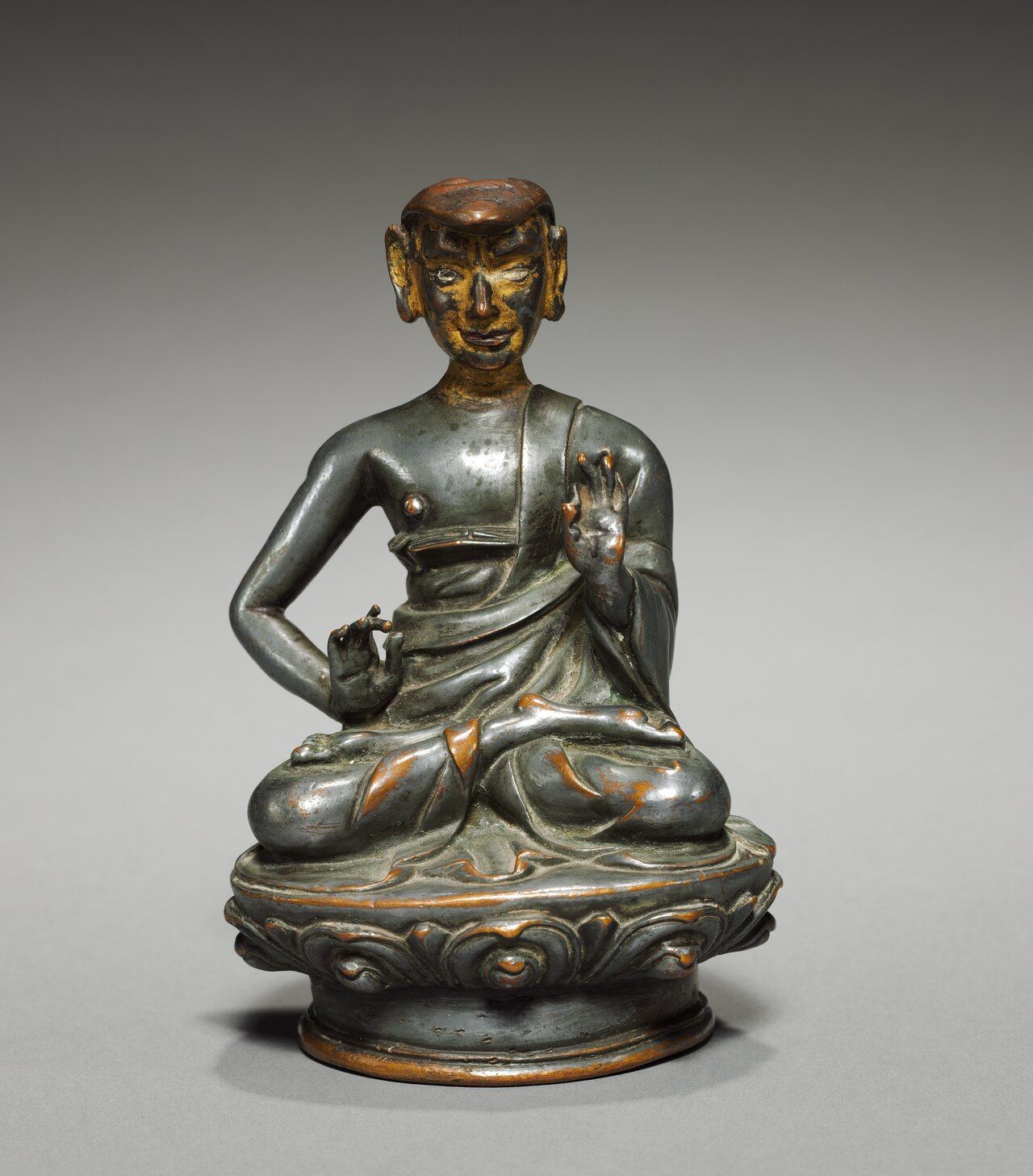
Little is reliably known of Dharmakīrti’s life. Tibetan sources say he was born in South India and studied at the great monastic university of Nālandā. Scholars still debate whether he lived in the sixth or seventh century; the dates given here are those proposed by Erich Frauwallner.
Building on the work of Dignāga, he developed a rigorous theory of the two sources of knowledge: perception, which grasps momentary particulars, and inference, which works with concepts formed by “exclusion”, that is, by marking off what something is not. His writings became the backbone of Buddhist epistemology in India and Tibet.
Key ideas
- Only particulars are real
- What is real is the particular, which has causal powers and exists for a single moment. Universals are unreal, at most fictions that thought and language need.
- Knowledge as reliable cognition
- A source of knowledge is a cognition reliable enough to act on. We confirm a perception when the object turns out to have the powers we expected, as when the pot we saw really does hold water.
- Words and apoha
- Particulars are grasped properly only by perception; words and concepts can’t capture them, and the kinds we name, like “cow”, are fictions. Dharmakīrti explained how thought can still be about reality with the theory of apoha (“exclusions”).
- Reasoning in the service of liberation
- Dharmakīrti used logic and the theory of knowledge to argue for Buddhist teachings such as the Four Noble Truths, karma and rebirth. He also advocated a form of meditation in which philosophical analysis is indispensable.
- Tradition
- Indian
- Region
- India
- Themes
- Knowledge and scepticism
Influences
Key works
- Commentary on Valid Cognition (Pramāṇavārttika)
Sources
- Tom Tillemans, Dharmakīrti, Stanford Encyclopedia of Philosophy