Philosopher
Peter Abelard
c. 1079 – 1142
Also known as Pierre Abélard, Abailard, Petrus Abaelardus
The pre-eminent philosopher of the twelfth century, a great logician and the first great nominalist, who held that intention alone makes an act right or wrong.
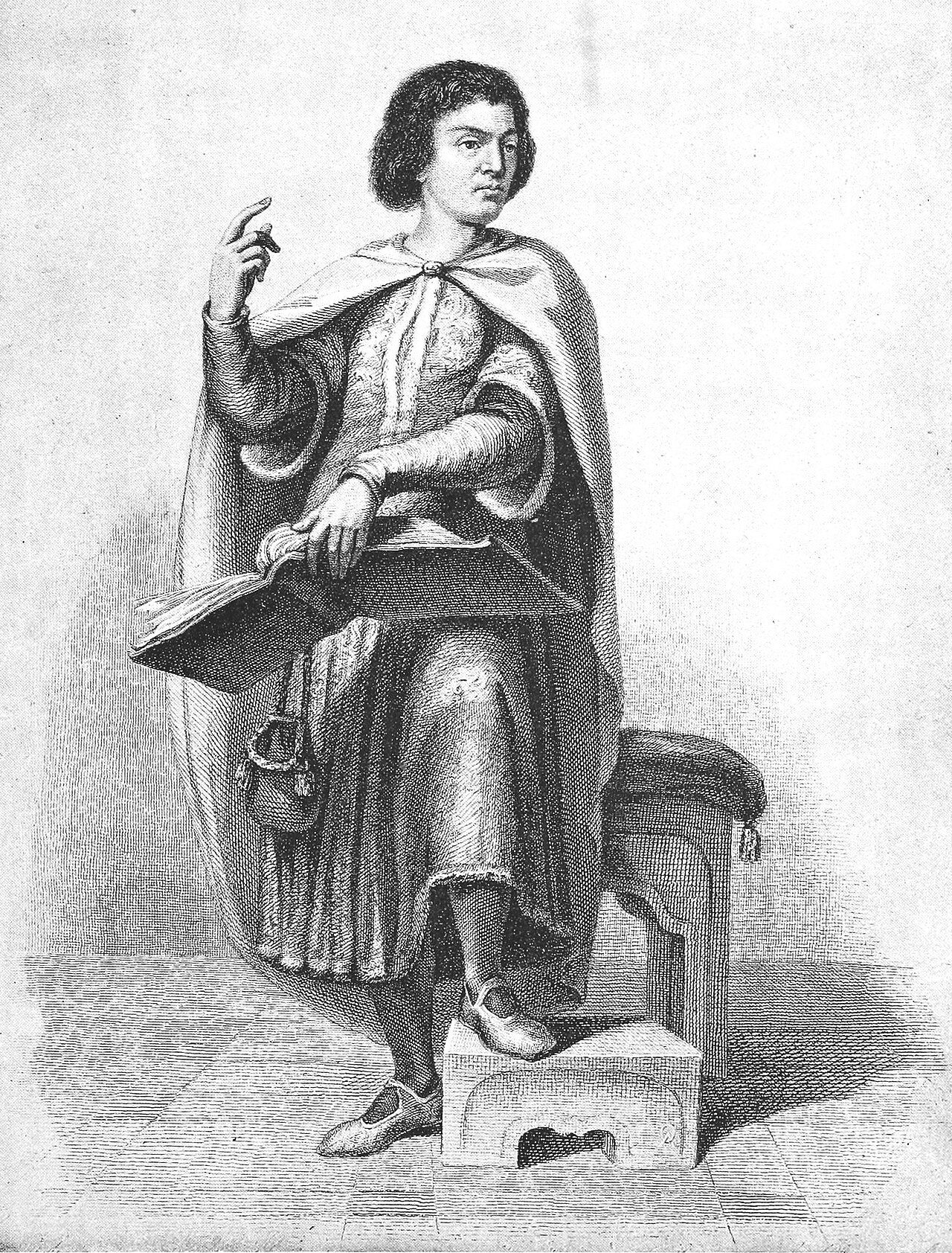

Abelard was born around 1079 in Le Pallet in Brittany. He gave up his inheritance and knighthood to study philosophy, notably with Roscelin and William of Champeaux, whom he later bested in debate over universals. As the leading teacher in Paris, he was said never to have lost an argument. His affair with Héloïse ended in his castration; he became a monk at Saint-Denis and she a nun, and their later letters are famous.
His theology was condemned at Soissons and, after a clash with Bernard of Clairvaux, at Sens in 1140. He died in 1142. Before the recovery of Aristotle’s works in the Latin West, he brought the native Latin tradition of philosophy to its highest point. His logic built heavily on Boethius’s commentaries, and he has a strong claim to be the finest logician of the medieval period.
Key ideas
- Universals are words
- Nothing in the world can be present as a whole in many things at once, as a universal would have to be; the same “animal” would then be both rational and irrational. Universality belongs to language, not to things; only individuals exist.
- Force and content
- The same content, that Socrates is in the house, can be asserted, asked or wished for. Separating a sentence’s force from its content let Abelard build a truth-functional logic of propositions and a theory of valid inference.
- Intention is what counts
- The moral worth of an act lies wholly in the agent’s intention; deeds in themselves are morally indifferent. Two people who intend the same good act are equally good, even if only one of them is able to carry it out.
- Reason in matters of faith
- Abelard gave reason a real but limited role in theology, and was the first to use “theology” in its modern sense. This set him against Bernard of Clairvaux, who had his teachings condemned.
Influences
Where these links come from
- Peter Abelard drew on Augustine. Source: Christian Tornau, Augustine of Hippo, Stanford Encyclopedia of Philosophy
- Peter Abelard drew on and argued against Boethius. Source: Peter King and Andrew Arlig, Peter Abelard, Stanford Encyclopedia of Philosophy
Key works
- Logic (Logica 'ingredientibus')
- Dialectic (Dialectica)
- Ethics, or Know Yourself (Scito te ipsum)
- The Story of My Troubles (Historia calamitatum)
- Read free at Project Gutenberg (translated by Henry Adams Bellows, as Historia Calamitatum)
Sources
- Peter King and Andrew Arlig, Peter Abelard, Stanford Encyclopedia of Philosophy
- John Marenbon, Anicius Manlius Severinus Boethius, Stanford Encyclopedia of Philosophy
- Christian Tornau, Augustine of Hippo, Stanford Encyclopedia of Philosophy