Philosopher
Jeremy Bentham
1748–1832
English jurist and reformer who gave utilitarianism its first systematic form, holding that pleasure and pain are our sovereign masters and that law should promote the greatest happiness.
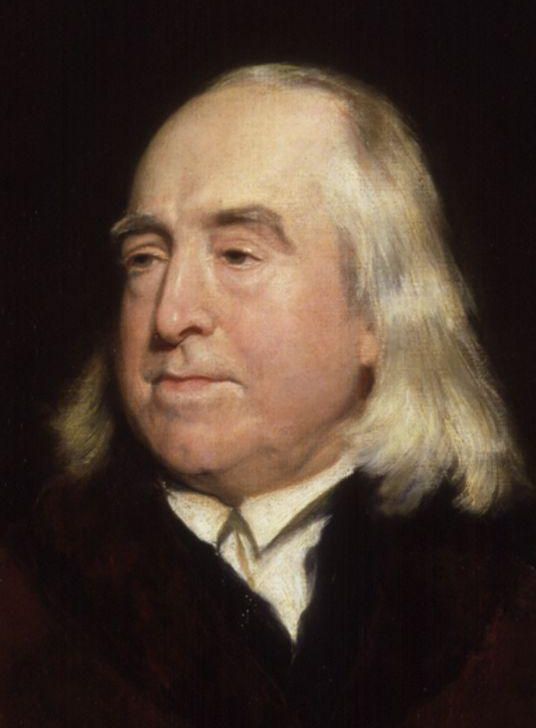

Nature has placed mankind under the governance of two sovereign masters, pain and pleasure. It is for them alone to point out what we ought to do, as well as to determine what we shall do.
The son of an attorney, Bentham was born in London in February 1748. His unhappy schooling at Westminster and Queen’s College, Oxford, left him distrustful of the Anglican establishment. Called to the bar in 1769, he found the principle of utility in the writings of Hume, Helvétius and Beccaria that same year, and chose a life of legal theory and reform instead of practice. He died in London on 6 June 1832.
Earlier moralists, among them Hume, had set out many of utilitarianism’s core ideas, but it was Bentham who gave the theory its secular, systematic form and made it a tool for criticising and improving law, morals and politics. His writings range over ethics, logic, political economy, punishment, education, religion and democratic government, and John Stuart Mill, brought up as a Benthamite radical, went on to rework his utilitarianism.
Key ideas
- Two sovereign masters
- Pain and pleasure alone determine what we do and point out what we ought to do. The principle of utility builds on this: actions and laws are right as they tend to increase happiness.
- Measuring pleasure
- The value of a pleasure or pain depends on its intensity, duration, certainty and nearness, on its fecundity and purity, and, where many people are affected, on its extent. This is often called the “felicific calculus”.
- The greatest happiness of all
- Bentham came to see that “the greatest happiness of the greatest number” could justify sacrificing a minority. He replaced it with the greatest happiness principle: the more closely we approach the happiness of every member of the community, the greater the total.
- Law as a tool of reform
- Bentham devoted his life to a complete body of law based on utility, and to reforming punishment, prisons, education and government, including his design for the Panopticon prison.
- Tradition
- Western
- Region
- London
- Schools
- Utilitarianism
- Period
- Early modern
Influences
Where these links come from
- Jeremy Bentham drew on David Hume. Source: James E. Crimmins, Jeremy Bentham, Stanford Encyclopedia of Philosophy
- John Stuart Mill drew on and argued against Jeremy Bentham. Source: Christopher Macleod, John Stuart Mill, Stanford Encyclopedia of Philosophy
Key works
- A Fragment on Government, 1776
- An Introduction to the Principles of Morals and Legislation, 1789
- Panopticon, 1791
Sources
- James E. Crimmins, Jeremy Bentham, Stanford Encyclopedia of Philosophy
- Christopher Macleod, John Stuart Mill, Stanford Encyclopedia of Philosophy