Philosopher
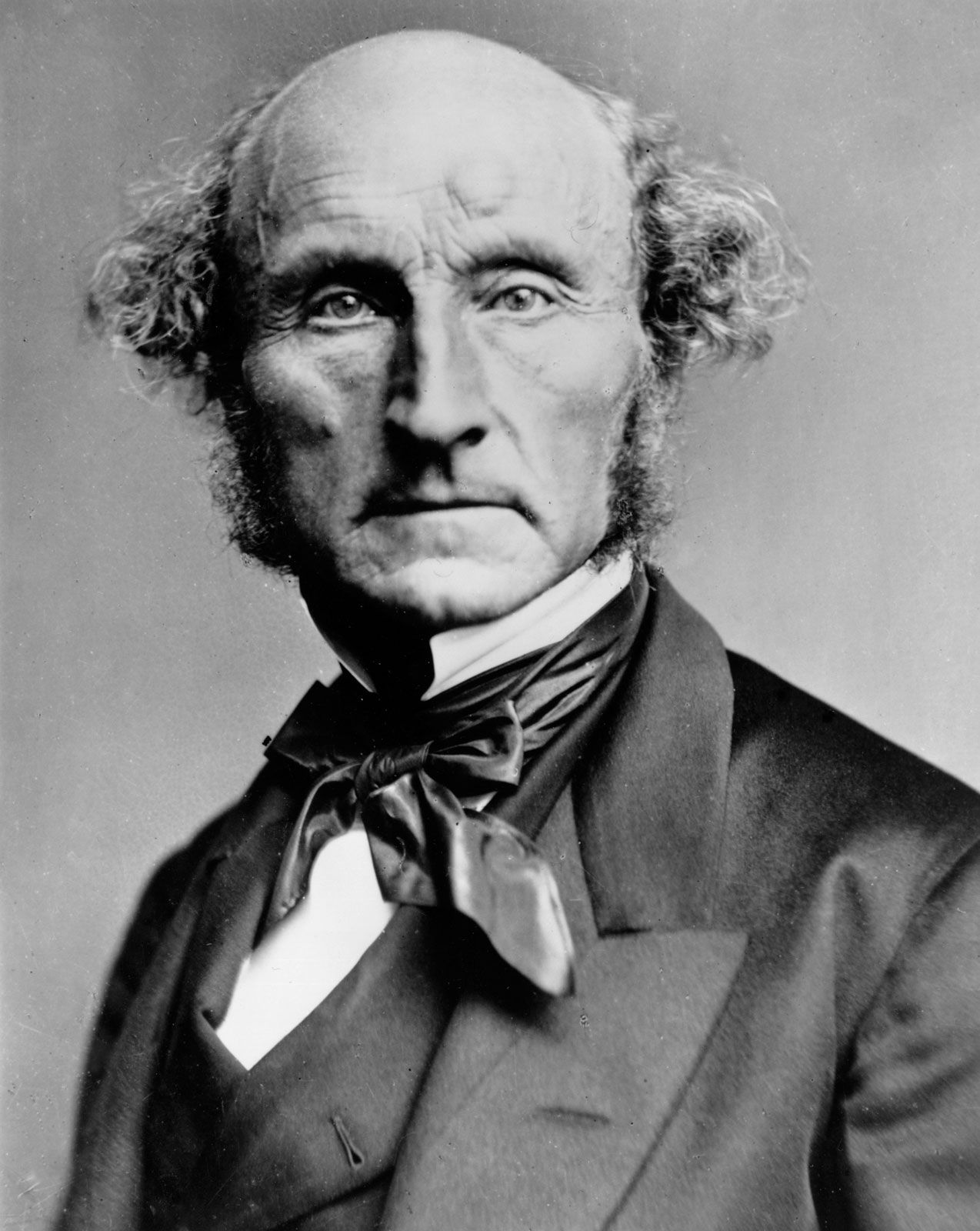
John Stuart Mill
1806–1873
The most influential English-language philosopher of the nineteenth century: an empiricist, a utilitarian and a liberal, author of On Liberty.

The only purpose for which power can be rightfully exercised over any member of a civilised community, against his will, is to prevent harm to others.
It is better to be a human being dissatisfied than a pig satisfied; better to be Socrates dissatisfied than a fool satisfied.
John Stuart Mill was given a famously intensive education by his father, James Mill, a follower of Jeremy Bentham. He worked for the East India Company, sat briefly in Parliament, and wrote across logic, economics, ethics and politics, working out the consequences of a thoroughly empiricist outlook while drawing on the Romantic and historical thought of his century.
In Utilitarianism he defended the view that actions are right as they tend to promote happiness, and argued that some pleasures are higher than others. On Liberty (1859) sets out the “harm principle”: society may interfere with individuals’ liberty only to prevent harm to others. He acknowledged his wife, Harriet Taylor, as a close intellectual partner in his work.
Key ideas
- Happiness as the test of conduct
- “Happiness is the sole end of human action, and the promotion of it the test by which to judge of all human conduct.” By happiness Mill meant pleasure and the absence of pain.
- Higher and lower pleasures
- Unlike Bentham, Mill held that pleasures differ in quality as well as quantity. Pleasures of the intellect, the feelings and imagination, and the moral sentiments are among the higher ones.
- The harm principle
- “The sole end for which mankind are warranted … in interfering with the liberty of action of any of their number, is self-protection.” Mill feared the tyranny of public opinion in a democracy as much as that of kings.
- Freedom of speech
- No opinion should be silenced, whether it is true, false or partly true. Even false opinions provoke debate that deepens our understanding; unchallenged truths shrink to “phrases retained by rote”.
- Human beings are part of nature
- Mill’s whole outlook is naturalist. The mind has no exalted place outside nature, and all our knowledge, even of arithmetic and geometry, ultimately rests on experience.
- Tradition
- Western
- Region
- England
- Period
- Late modern
- Themes
- The good life
Key works
- A System of Logic, 1843
- On Liberty, 1859
- Utilitarianism
Sources
- Christopher Macleod, John Stuart Mill, Stanford Encyclopedia of Philosophy