Philosopher
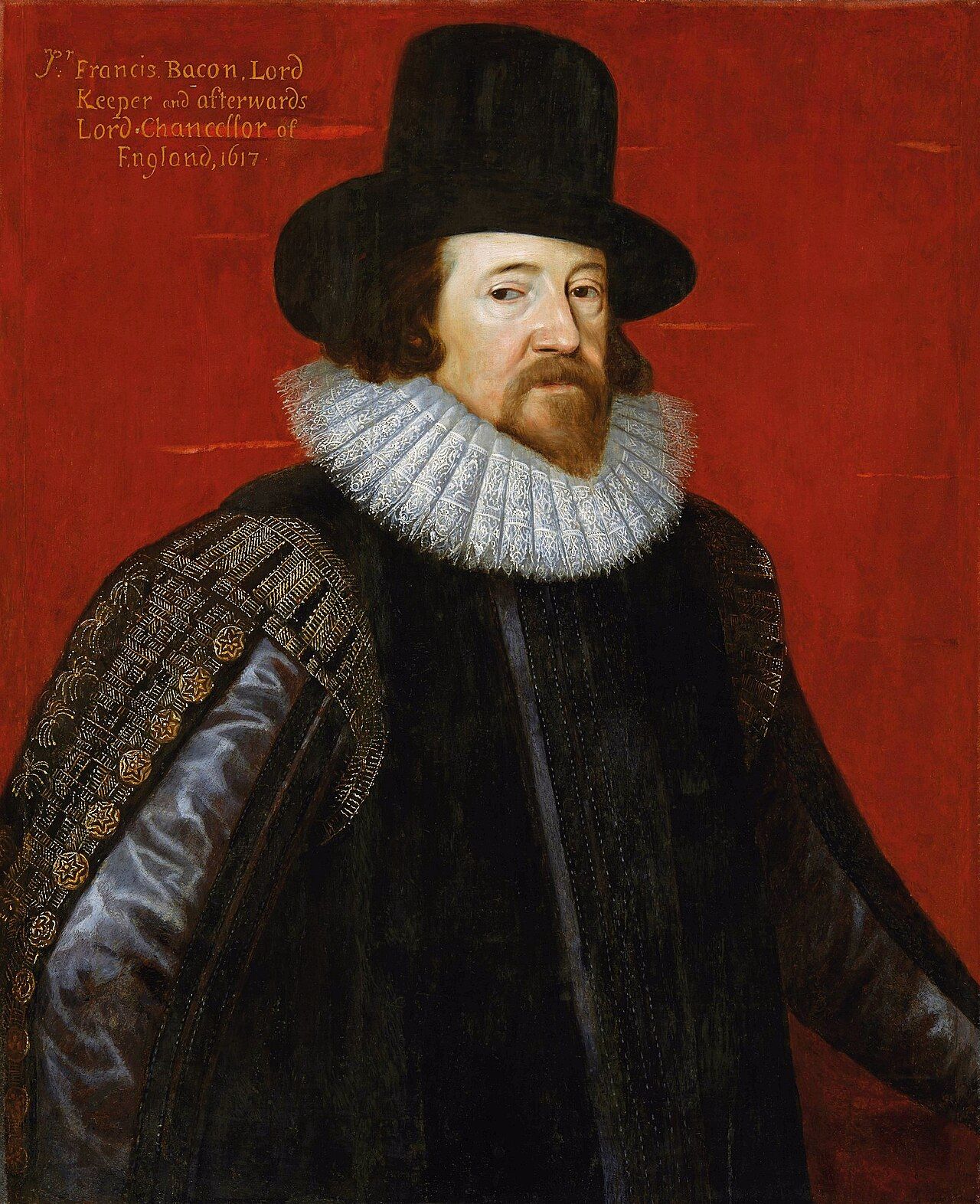
Francis Bacon
1561–1626
Also known as Lord Verulam, Viscount St Alban
English statesman and philosopher who planned a great renewal of all knowledge, based on experiment, a new method of induction and the conviction that knowledge is power.

If a man will begin with certainties, he shall end in doubts; but if he will be content to begin with doubts, he shall end in certainties.
Francis Bacon was born in London on 22 January 1561, the son of Sir Nicholas Bacon, Lord Keeper. He studied at Trinity College, Cambridge, and trained as a lawyer, sat in Parliament for forty years, argued for law reform, and wrote popular Essays and a history of Henry VII. He became Lord Chancellor in 1618, but in 1621 Parliament impeached him for taking bribes and he confessed. He died at Highgate on 9 April 1626.
Above all he was a philosopher, and his great project was the Instauratio magna, a renewal of all knowledge, especially natural philosophy. He attacked both the disputations of the scholastics and the “blind experiments” of the alchemists. His works were read and debated across Europe within a few years of publication, including by Gassendi, Mersenne and Descartes.
Key ideas
- Knowledge for use
- The aim of all knowledge is to produce practical effects and improve human life. Knowledge and power are closely linked: understanding nature’s causes is what lets us act on it.
- The idols of the mind
- Four kinds of illusion distort inquiry. The idols of the tribe come from human nature, those of the cave from each person’s upbringing, those of the market-place from words, and those of the theatre from philosophical systems.
- A new organon
- Bacon meant his method to replace Aristotle’s logic, the Organon. It starts from the senses, corrected by experiment and instruments, and proceeds by eliminative induction, building on careful natural histories.
- Science as a shared enterprise
- Learning advances only by collaboration and needs institutions. In New Atlantis, Bacon imagined Salomon’s House, a college of researchers organised to discover nature’s secrets.
- Tradition
- Western
- Region
- London
- Period
- Early modern
- Themes
- Knowledge and scepticism
Influences
Where these links come from
- Francis Bacon argued against Aristotle. Source: Markku Peltonen, Francis Bacon, Stanford Encyclopedia of Philosophy
- Francis Bacon drew on Michel de Montaigne. Source: Marc Foglia and Emiliano Ferrari, Michel de Montaigne, Stanford Encyclopedia of Philosophy
Key works
- The Advancement of Learning, 1605
- Novum Organum, 1620
- Read free at Project Gutenberg (edited by Joseph Devey)
- New Atlantis
- Essays
Sources
- Markku Peltonen, Francis Bacon, Stanford Encyclopedia of Philosophy
- Marc Foglia and Emiliano Ferrari, Michel de Montaigne, Stanford Encyclopedia of Philosophy