Philosopher
al-Kindi
c. 800 – c. 870 CE
Also known as Alkindus, Abu Yusuf Ya‘qub ibn Ishaq al-Kindi
The first self-identified philosopher in the Arabic tradition, who worked with translators of Greek philosophy and argued that philosophy and revelation agree.
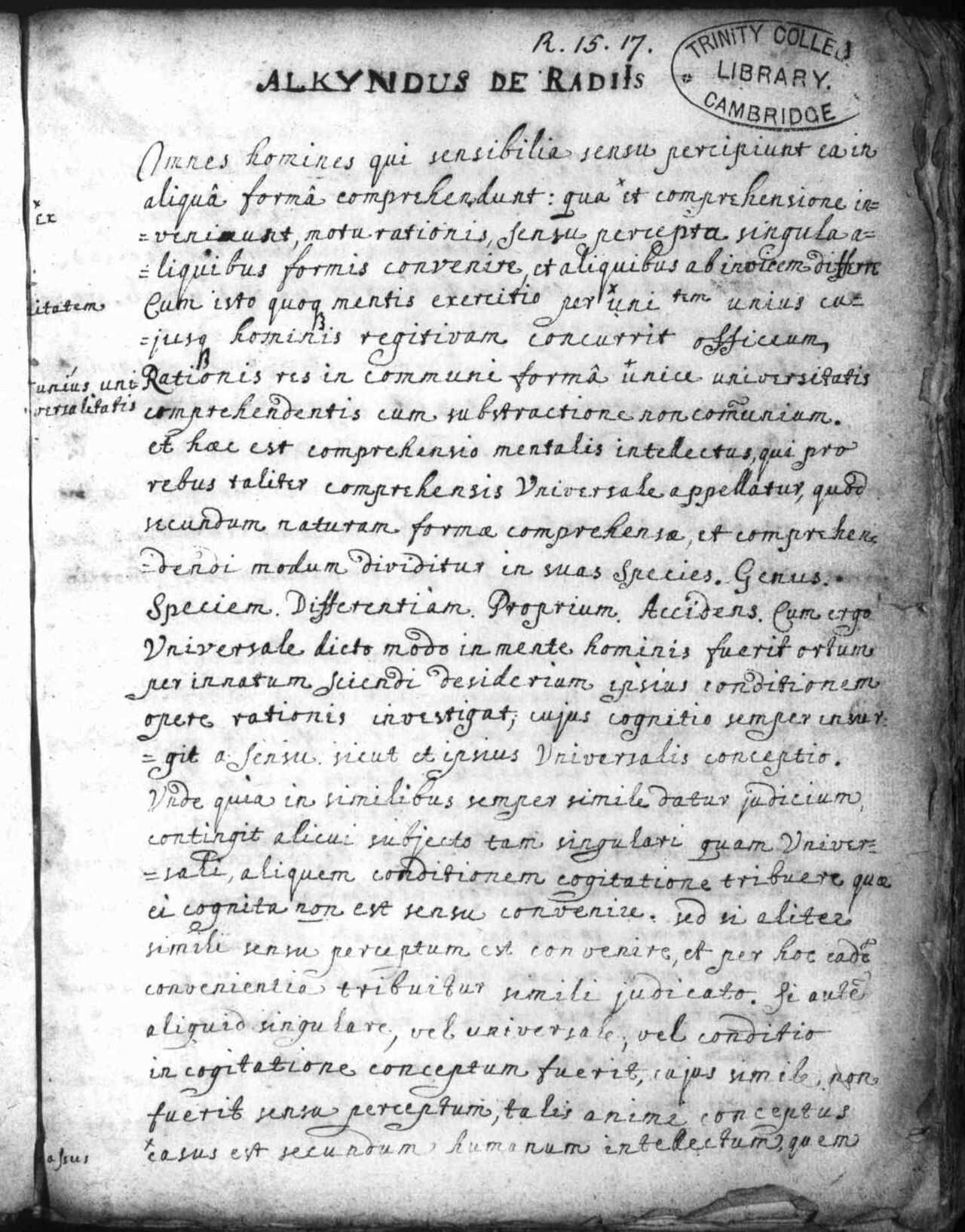
,_secolo_XVII_%E2%80%93_BEIC_11521297.jpg)
We must not be ashamed to admire the truth or to acquire it, from wherever it comes.
Al-Kindi worked in Baghdad under the Abbasid caliphs, alongside a circle of translators who rendered Aristotle, Neoplatonic writers and Greek mathematicians and scientists into Arabic. Their translations included the so-called Theology of Aristotle, in fact drawn from Plotinus, and many of al-Kindi’s own treatises were letters to members of the caliph’s family.
His thought blends Aristotle with Neoplatonism. He wrote on metaphysics, the soul, mathematics, optics and music, and argued that philosophy, the search for truth, supports the teachings of Islam: in On First Philosophy he argues that the world is not eternal but was created.
Key ideas
- Truth from wherever it comes
- “We must not be ashamed to admire the truth or to acquire it, from wherever it comes”, even from “far-flung nations and foreign peoples”. Al-Kindi used this principle to welcome Greek philosophy into Arabic thought.
- God as the true One
- First philosophy is knowledge of God, “the first truth and the cause of all truth”. Al-Kindi argued for a simple “true One” that causes the unity, and so the very being, of everything else.
- The world had a beginning
- Against Aristotle and most Greek philosophers, and drawing on arguments from Philoponus, al-Kindi argued that the world is not eternal but has a beginning in time.
- Mathematics as method
- Mathematics was fundamental to al-Kindi’s philosophical method. He applied it wherever he could, from geometry in optics to the theory of compound drugs and music.
- Tradition
- Arabic and Islamic
- Region
- Baghdad
- Period
- Classical Islamic
- Themes
- Faith and reason
Influences
Influenced by
al-Kindic. 800 – c. 870 CE
Influenced by
al-Kindic. 800 – c. 870 CE
Key works
- On First Philosophy (Fi al-falsafa al-ula)
Sources
- Peter Adamson, al-Kindi, Stanford Encyclopedia of Philosophy