Philosopher
Rāmānuja
c. 1077 – c. 1157
Also known as Ramanuja, Rāmānujācārya
Chief proponent of Viśiṣṭādvaita, “qualified non-dualism”, which affirms both the unity of all in God and the reality of individual persons and things.
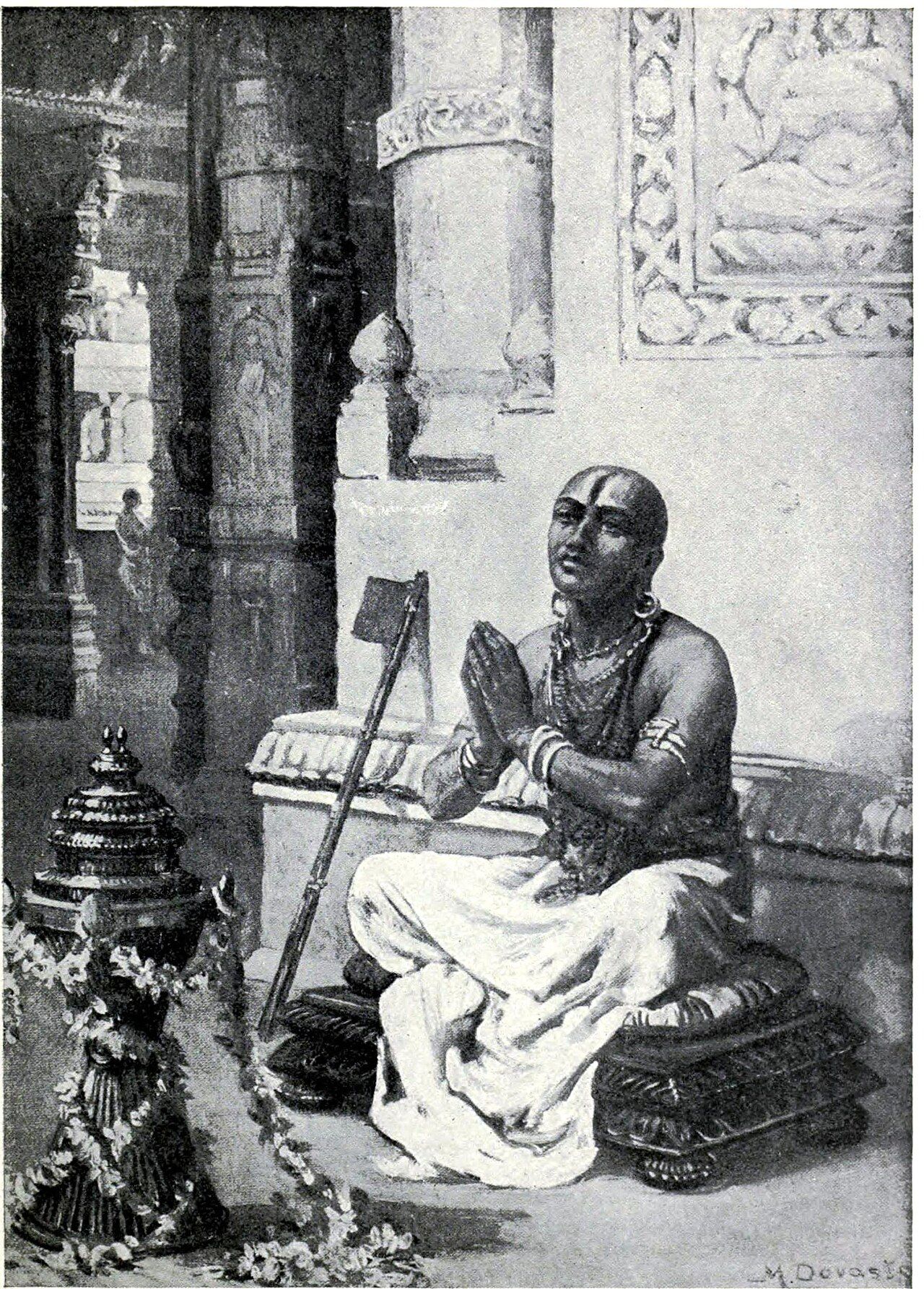

Rāmānuja was born in Śrīperumbūdur in the Tamil-speaking south of India. Tradition holds that he lived to 120, from 1017 to 1137; recent scholarship places his life between about 1077 and 1157, the dates used here.
He was the chief proponent of Viśiṣṭādvaita, “qualified non-dualism”, one of the three main forms of Vedānta. Against the Advaita view that plurality is ultimately unreal, he defended the reality of individual persons, qualities and objects, while holding that all are united in God, as a body is united with its self. He also argued for the importance of bhakti, devotion to a personal God, both for knowledge and for liberation.
Key ideas
- Qualified non-dualism (Viśiṣṭādvaita)
- Better rendered “non-duality of the qualified whole”. Rāmānuja affirmed the unity of all things without giving up the reality of distinct persons, qualities, universals and moral and aesthetic values.
- The world as Brahman’s body
- Brahman stands to everything else as the soul stands to its body. Individuals are Brahman by being part of its body, yet each keeps its own identity.
- Individuals are real
- Against Advaita, Rāmānuja argued that only an individual can be ignorant, and Brahman, whose nature is knowledge, cannot be. So the individual person can’t be an illusion produced by ignorance.
- Devotion as knowledge (bhakti)
- Devotion is itself a direct awareness of Brahman’s nature, a kind of seeing, and so a form of knowledge. Rāmānuja’s view of bhakti as a state of knowledge was his distinctive contribution to Indian epistemology.
- Tradition
- Indian
- Region
- South India
Influences
Key works
- Commentary on the Brahmasūtra (Śrī Bhāṣya)
- Read free at Project Gutenberg (translated by George Thibaut)
- Summary of the Meaning of the Vedas (Vedārthasaṅgraha)