Philosopher
Ludwig Wittgenstein
1889–1951
Austrian-born philosopher of logic and language whose Tractatus and later Philosophical Investigations transformed analytic philosophy twice over.
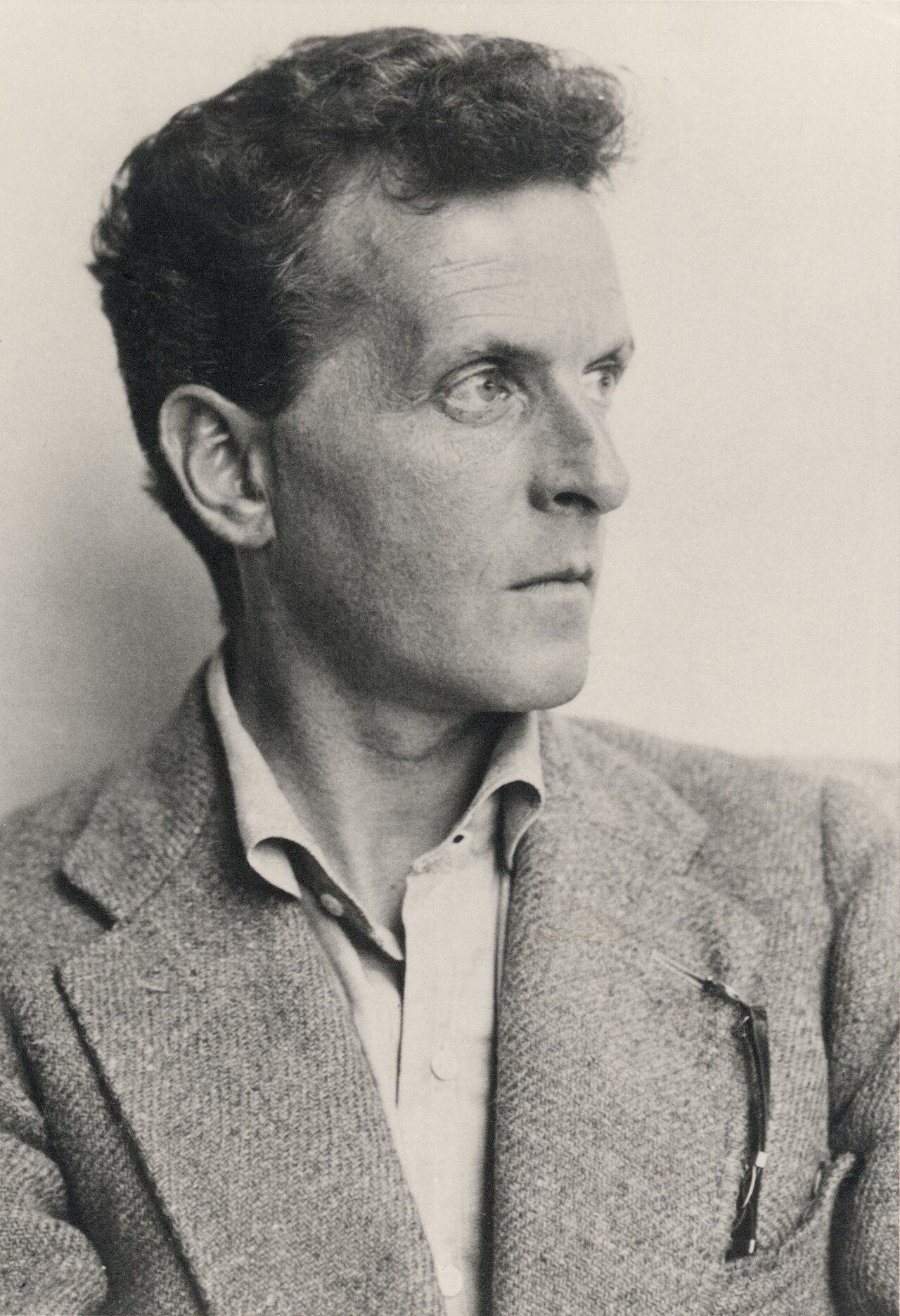

Whereof one cannot speak, thereof one must be silent.
Born in Vienna, Ludwig Wittgenstein came to Cambridge to study with Bertrand Russell. His Tractatus Logico-Philosophicus (1921) argued that language pictures the world, and that what cannot be said must be passed over in silence. Believing he had solved philosophy’s problems, he left it for years, before returning to Cambridge in 1929.
His later thought, published after his death as the Philosophical Investigations (1953), rejects much of the Tractatus. The meaning of a word lies in its use within “language-games” embedded in forms of life, and many philosophical problems arise from misunderstanding how language works. Considered by some the greatest philosopher of the twentieth century, he remains central and controversial.
Key ideas
- Propositions as pictures
- In the Tractatus, a meaningful proposition is a logical picture of a possible state of affairs. So only facts that can be pictured can be meaningfully said, and “the totality of true propositions is the total natural science”.
- “Whereof one cannot speak …”
- The Tractatus draws a limit to the expression of thought; what lies beyond it is nonsense. Most philosophical propositions “are not false but nonsensical”, and it ends, “Whereof one cannot speak, thereof one must be silent.”
- Meaning as use
- “The meaning of a word is its use in the language.” In his later work Wittgenstein turned from meaning as representation to how words are actually used in human activity.
- Language-games and family resemblance
- There is no single essence shared by everything we call a “game”, or “language”. Uses of a word are linked by “a complicated network of similarities overlapping and criss-crossing”, like the resemblances within a family.
- Philosophy as therapy
- Philosophy offers no theories or explanations. “Philosophy just puts everything before us”, and the philosopher’s work is “marshalling reminders” to dissolve confusions, using many methods, “different therapies, as it were”.
- Tradition
- Western
- Region
- Vienna and Cambridge
- Period
- Contemporary
Influences
Key works
- Tractatus Logico-Philosophicus (Logisch-philosophische Abhandlung), 1921
- Philosophical Investigations (Philosophische Untersuchungen), 1953
Sources
- Anat Biletzki and Anat Matar, Ludwig Wittgenstein, Stanford Encyclopedia of Philosophy