Philosopher
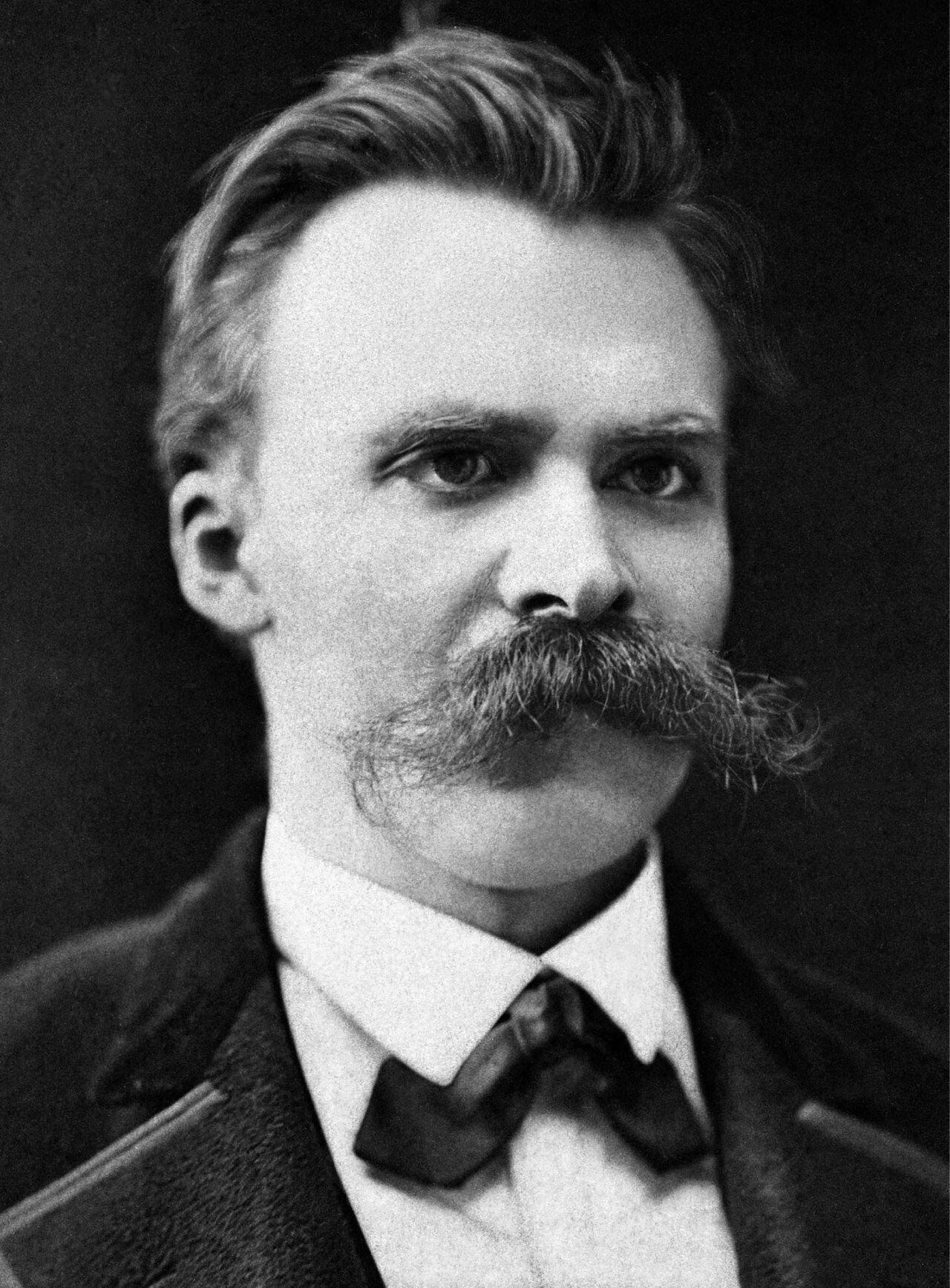
Friedrich Nietzsche
1844–1900
German philosopher and cultural critic who attacked traditional morality and religion, announced that “God is dead”, and asked how life can be affirmed without them.

God is dead! God remains dead! And we have killed him!
Friedrich Nietzsche was appointed professor of classical philology at Basel at 24. His health, always fragile, repeatedly interrupted his teaching, and in the 1870s and 1880s he published intensively, from The Birth of Tragedy to Thus Spoke Zarathustra, Beyond Good and Evil and On the Genealogy of Morality. He suffered a collapse in 1889 and wrote nothing more.
Nietzsche argued that traditional morality and religion rest on psychological needs that people conceal from themselves, and that the “death of God” leaves European culture facing nihilism. Against this he explored ideas such as the will to power and the eternal recurrence, as ways of affirming life. He was strongly influenced by Schopenhauer.
Key ideas
- “God is dead”
- The point isn’t simply that atheism is true. Because belief in the Christian God “has become unbelievable”, everything built on it, including “the whole of our European morality”, is destined to collapse.
- The slave revolt in morality
- People oppressed by the powerful developed ressentiment, a corrosive, resentful hatred. It gave birth to the concept of “evil” to condemn their masters, and then to a new idea of “good” as altruistic concern.
- The will to power
- Everything that exists may rest on “power-centres” that seek to expand their power. What Nietzsche meant by this is fiercely debated: metaphysics, psychology, or a rejection of metaphysics.
- Perspectivism
- Earlier philosophers ignored how their own perspectives shaped their thinking. Nietzsche held that all knowing is from some perspective, and that more perspectives give a fuller understanding.
- Eternal recurrence
- Nietzsche called it his most important thought: imagining that every event repeats itself, in the same order, through an eternal series of cycles. Early readers took it as a claim about the structure of time, but what he meant is still disputed.
- Tradition
- Western
- Region
- Germany, Switzerland and Italy
- Period
- Late modern
- Themes
- The good life
Influences
Key works
- The Birth of Tragedy (Die Geburt der Tragödie)
- Read free at Project Gutenberg (translated by William A. Haussmann)
- Thus Spoke Zarathustra (Also sprach Zarathustra)
- Read free at Standard Ebooks (translated by Thomas Common)
- Beyond Good and Evil (Jenseits von Gut und Böse)
- Read free at Standard Ebooks (translated by Helen Zimmern)
- On the Genealogy of Morality (Zur Genealogie der Moral)
- Read free at Standard Ebooks (translated by Horace B. Samuel)
Sources
- R. Lanier Anderson, Friedrich Nietzsche, Stanford Encyclopedia of Philosophy