Philosopher
Diogenes of Sinope
c. 404 – c. 323 BCE
Also known as Diogenes the Cynic
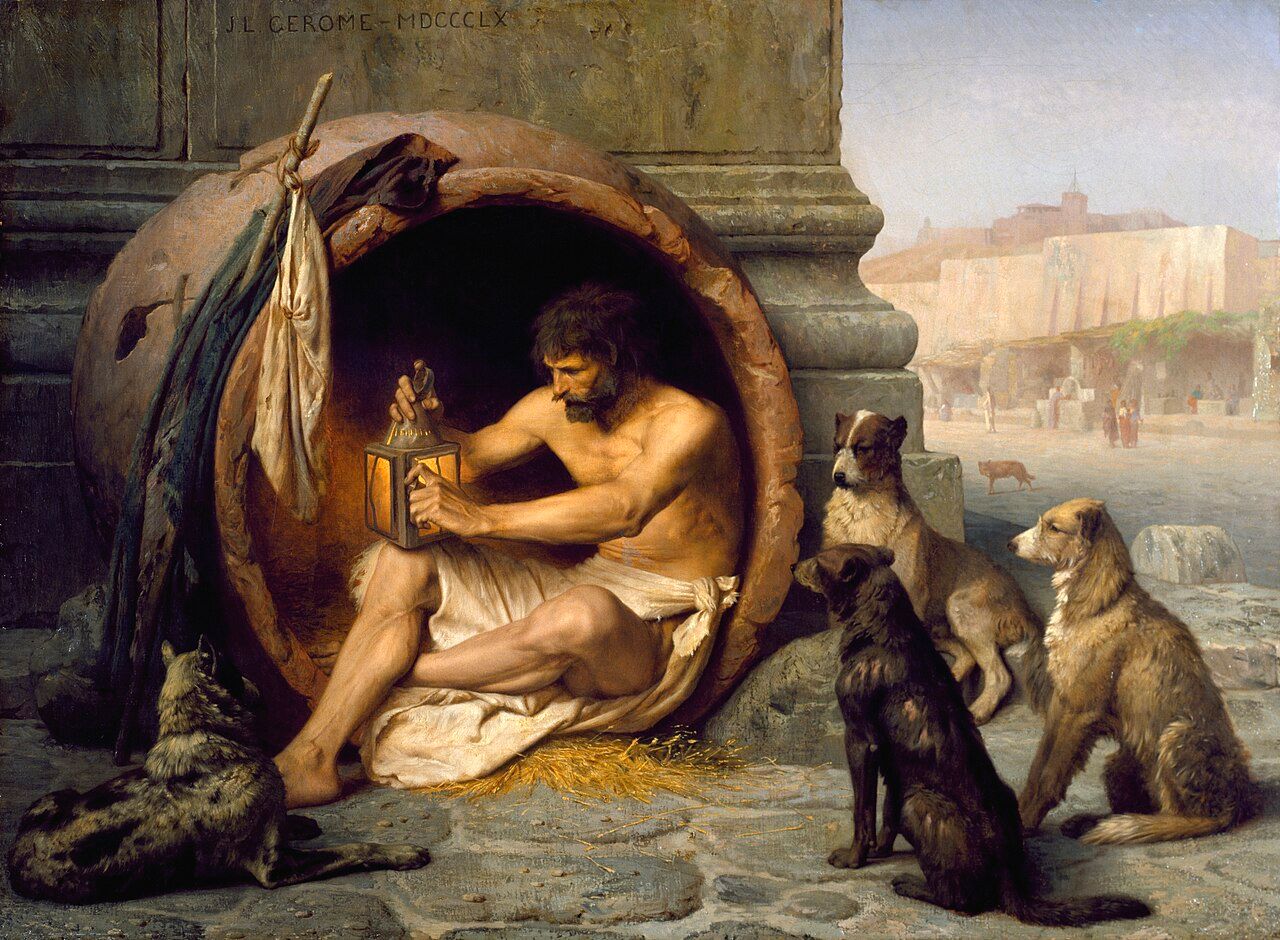
The model Cynic, who lived in a storage jar in Athens, flouted convention to show that a life according to nature and reason needs almost nothing, and called himself a citizen of the world.

I am a citizen of the world.
But he claimed that to fortune he could oppose courage, to convention nature, to passion reason.
Diogenes left his native Sinope, on the Black Sea, after a scandal over the defacing of the city’s coinage; whether he or his father was responsible is unclear, but coins confirm that it happened. In Athens he made his home in a storage jar, and he is said to have attached himself to Antisthenes, a companion of Socrates, though the dates make this doubtful. Other stories tell of his capture by pirates and sale as a slave in Corinth, where he told his buyer that his skill was governing men. He lived to a great age. It is not even certain that he wrote anything; for him the way one lived was the real philosophical work.
Plato is said to have called him “a Socrates gone mad”, and Diogenes returned the scorn, mocking Plato’s definitions and his metaphysics. His shamelessness and theatrical gestures, such as carrying a lamp in daylight in search of a human being, were meant to expose the unreason of custom and to promote virtue. The Stoics owed much to the Cynics: their founder, Zeno of Citium, studied with Diogenes’ pupil Crates, and Stoics counted Diogenes among the rare examples of a wise man.
Key ideas
- Nature over convention
- Custom has no authority where it conflicts with nature and reason. Nothing acceptable behind closed doors becomes shameful merely by being done in the open, so Diogenes ate in the marketplace because that was where he felt hungry.
- Training for freedom
- By training (askēsis), walking barefoot in snow and embracing cold statues, he taught himself to do without what most people mistake for necessities. He said he had learned from watching a mouse that one can adapt to any circumstances.
- Reason or a halter
- For living well we need either right reason or a halter: either reason guides us, or like animals we must be led. He scorned knowledge that served no purpose, answering an argument that motion is impossible by getting up and walking.
- Citizen of the world
- Asked where he came from, he said he was a citizen of the world (kosmopolitēs), perhaps coining the word. He owed nothing to Sinope or any one city, only to the universe, and so could live by nature rather than local law.
- Frank speech
- The Cynics prized free and fearless speech (parrhēsia), whatever the risk. When Alexander the Great stood over him and offered him whatever he wanted, Diogenes asked him to stop blocking his sunlight.
- Tradition
- Western
- Region
- Sinope, on the Black Sea; Athens; Corinth
- Period
- Ancient Greek and Roman
Influences
Influenced by
Diogenes of Sinopec. 404 – c. 323 BCE
Influenced
Influenced by
Diogenes of Sinopec. 404 – c. 323 BCE
Influenced
Where these links come from
- Diogenes of Sinope drew on Socrates. Source: Julie Piering, Diogenes of Sinope, Internet Encyclopedia of Philosophy
- Diogenes of Sinope argued against Plato. Source: Julie Piering, Diogenes of Sinope, Internet Encyclopedia of Philosophy
- Epictetus drew on Diogenes of Sinope. Source: Julie Piering, Cynics, Internet Encyclopedia of Philosophy
Sources
- Julie Piering, Diogenes of Sinope, Internet Encyclopedia of Philosophy
- Julie Piering, Cynics, Internet Encyclopedia of Philosophy