Philosopher
Xenophanes
fl. 540–480 BCE
Also known as Xenophanes of Colophon
Wandering poet who mocked the idea that gods look and behave like humans, described one greatest god unlike mortals, and doubted that anyone can know the plain truth.
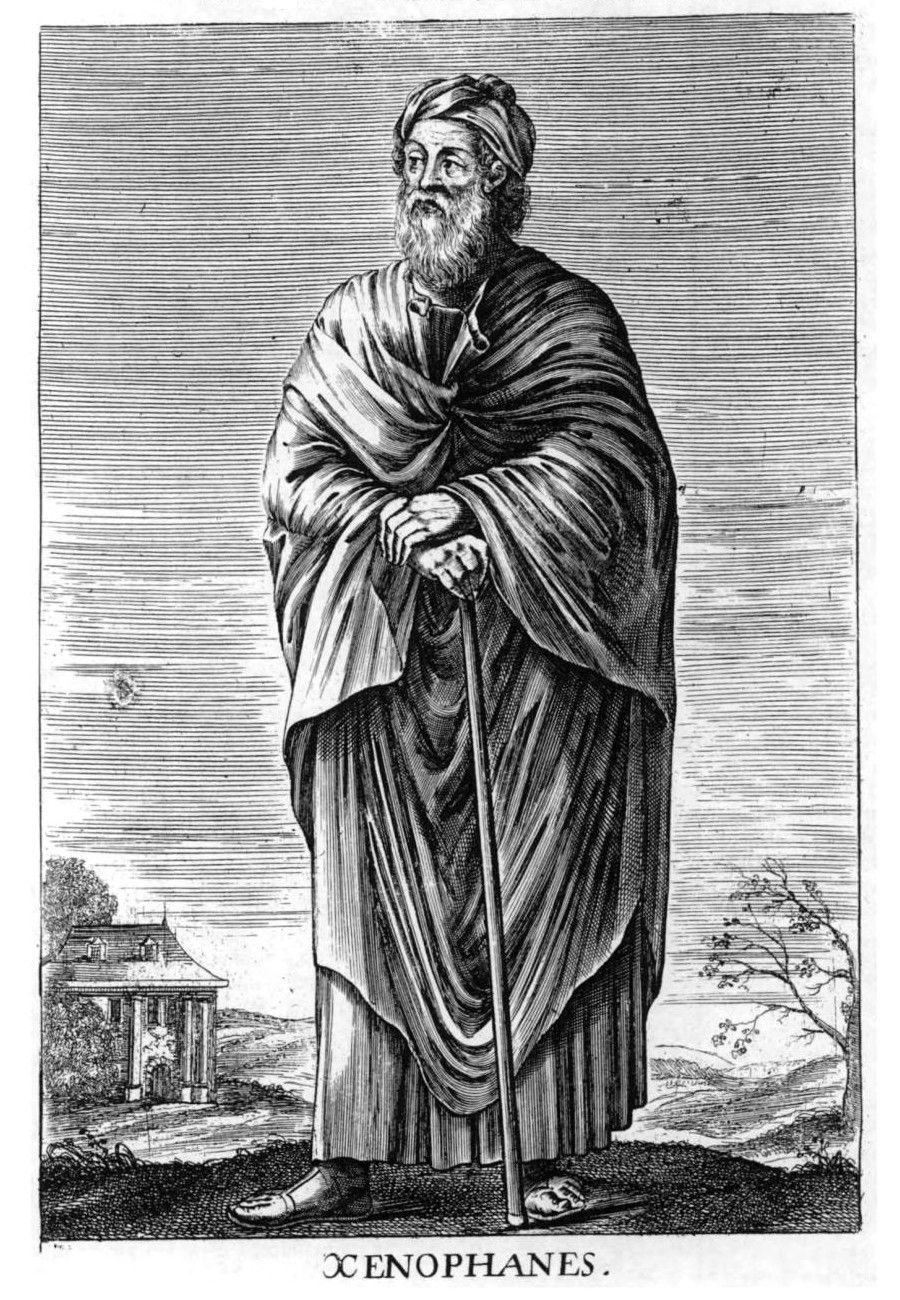

The Ethiopians make their gods black and snub-nosed; the Thracians say theirs have blue eyes and red hair.
The gods have not revealed all things to men from the beginning, but by seeking they find in time what is better.
Xenophanes was born in Colophon, a small Ionian town, and according to Diogenes Laertius was at his height around 540 BCE. Driven from his home, he spent the rest of a long life on the move: by his own account he had been travelling the Greek world for sixty-seven years, from the age of twenty-five, and he is linked with Elea in Italy and with towns in Sicily. He wrote in verse, performing his own poems, and about forty-five fragments survive, from drinking-party poems to satires on Homer and Hesiod.
He is remembered above all for his attack on gods made in human form and for his account of a single greatest god, the first more or less systematic theory of the divine in Greek thought. Plato and Aristotle linked him with Parmenides, and many later writers made him the founder of the Eleatic school, but the fragments show someone harder to classify: a critic of religion and of his society, an observer of nature in the Milesian manner, and a thinker about the limits of human knowledge. Several of his views, on the stories the poets tell of the gods and on the honours given to athletes, reappear in Plato’s Republic.
Key ideas
- Gods made in our image
- Homer and Hesiod credit the gods with theft, adultery and deceit, things people are blamed for. Every people pictures its gods in its own likeness, and if horses and oxen could draw, their gods would look like horses and oxen.
- One greatest god
- There is “one god greatest among gods and men”, unlike mortals in body or mind, who perceives with the whole of itself, moves everything by thought alone and never shifts its place. Whether this amounts to monotheism is debated, since the same line speaks of gods in the plural.
- Only opinion for mortals
- No one has seen, or will know, the clear and certain truth about the gods and the other things he speaks of; even someone who hit on the truth wouldn’t know it. Later sceptics claimed him as a forerunner, though many scholars now read him as a fallibilist rather than a sceptic.
- Inquiry into nature
- He knew the work of the Milesians and tried to improve on it, explaining much of nature through earth and water and giving clouds a large part in the weather and the heavens. Fossils of sea creatures found inland helped lead him to a theory that the earth passes through alternating ages of flood and drought.
- Tradition
- Western
- Region
- Colophon, Ionia; later Sicily and southern Italy
- Period
- Ancient Greek and Roman
Influences
Influenced by
Xenophanesfl. 540–480 BCE
Influenced by
Xenophanesfl. 540–480 BCE
Where these links come from
- Xenophanes drew on Thales. Source: James Lesher, Xenophanes, Stanford Encyclopedia of Philosophy
- Xenophanes drew on Anaximander. Source: James Lesher, Xenophanes, Stanford Encyclopedia of Philosophy
- Xenophanes argued against Pythagoras. Source: James Lesher, Xenophanes, Stanford Encyclopedia of Philosophy
Key works
- Poems (fragments)
Sources
- James Lesher, Xenophanes, Stanford Encyclopedia of Philosophy