Philosopher
W. V. O. Quine
1908–2000
Also known as Willard Van Orman Quine
Harvard logician and philosopher who attacked logical empiricism's distinction between analytic and synthetic truths and saw philosophy as continuous with science.
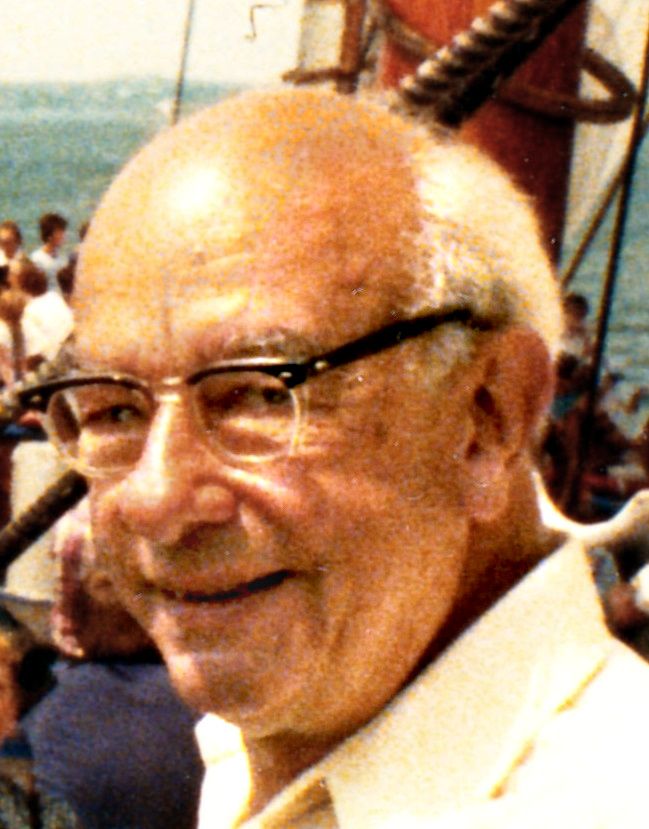

Science is not a substitute for common sense but an extension of it.
Quine was born in Akron, Ohio, in 1908. He studied mathematics at Oberlin College and wrote his Harvard doctorate on Whitehead and Russell’s Principia Mathematica. A travelling fellowship in 1932–33 took him to Vienna, Warsaw and Prague, where Rudolf Carnap, whose logical empiricism he would later attack, was then teaching.
He taught at Harvard from 1936 until 1978, apart from wartime service in naval intelligence, and wrote extensively on logic and set theory as well as on knowledge, language and ontology. His arguments of the early 1950s against logical empiricism, and his view that philosophy is continuous with natural science, have been extremely influential. He died in Boston on Christmas Day 2000.
Key ideas
- Naturalism
- It is “within science itself, and not in some prior philosophy, that reality is to be identified and described”. There is no first philosophy standing outside science; philosophy is in the same line of work, only more theoretical.
- Against the analytic–synthetic distinction
- Logical empiricists explained logic and mathematics as analytic, true by virtue of meaning. Quine rejected this, and after his work of the early 1950s philosophers could no longer take logical empiricism for granted.
- Holism
- Almost none of our knowledge faces experience one sentence at a time; a sentence is accepted for its contribution to our theory as a whole. Arithmetic seems a priori only because it lies near the centre of the “web of belief”, where giving it up would mean abandoning almost everything.
- Ontology from theory
- Our best theory, recast in first-order logic, tells us what exists: the objects its variables range over. For Quine these are physical objects, the contents of any portion of space-time, and sets.
- Indeterminacy of translation
- There may be different ways of translating a language that are equally correct and not mere stylistic variants of one another. Critics have called the idea absurd, or an extreme scepticism about whether we ever understand each other.
- Tradition
- Western
- Region
- United States
- Period
- Contemporary
Influences
Influenced by
W. V. O. Quine1908–2000
Influenced by
W. V. O. Quine1908–2000
Where these links come from
- W. V. O. Quine drew on Alfred North Whitehead. Source: Peter Hylton and Gary Kemp, Willard Van Orman Quine, Stanford Encyclopedia of Philosophy
- W. V. O. Quine drew on Bertrand Russell. Source: Peter Hylton and Gary Kemp, Willard Van Orman Quine, Stanford Encyclopedia of Philosophy
- W. V. O. Quine drew on and argued against Rudolf Carnap. Source: Peter Hylton and Gary Kemp, Willard Van Orman Quine, Stanford Encyclopedia of Philosophy
Key works
- Two Dogmas of Empiricism, 1951
- From a Logical Point of View, 1953
- Word and Object, 1960
- Ontological Relativity and Other Essays, 1969
- Pursuit of Truth, 1990
Sources
- Peter Hylton and Gary Kemp, Willard Van Orman Quine, Stanford Encyclopedia of Philosophy