Philosopher
Watsuji Tetsurō
1889–1960
Also known as Tetsurō Watsuji, Tetsuro Watsuji
Philosopher of ethics and culture who answered Heidegger's stress on time with space and climate, and defined the human being by the 'betweenness' of people.
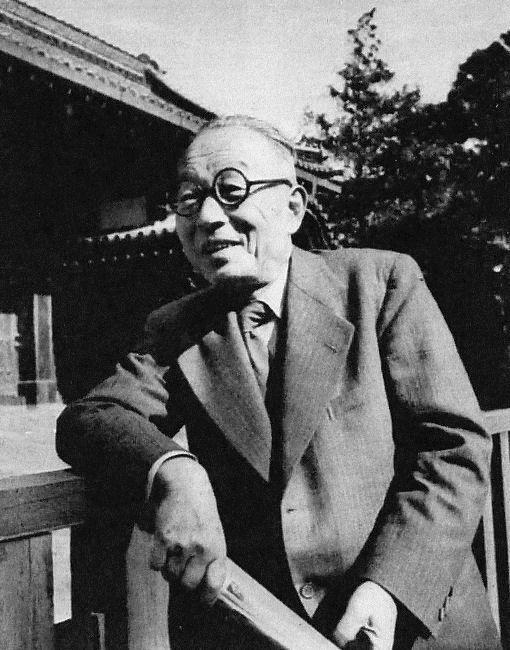

The communion between man and man does not mean their becoming merely one. It is only through the fact that men are unique individuals that a cooperation between ‘man and man’ can be realized.
Watsuji was born in 1889, the son of a physician, in Himeji. As a student he hoped to be a poet like Byron, and he wrote early studies of Schopenhauer, Nietzsche and Kierkegaard. Under the influence of the novelist Natsume Sōseki he turned from Western individualism to the resources of Japanese and Eastern culture, writing on the temples of Nara, ancient Japanese culture and the Zen master Dōgen, whose work he almost single-handedly brought out of obscurity.
In 1925 Nishida Kitarō brought him to Kyoto Imperial University to teach ethics. On a scholarship to Germany he was among the very first to read Heidegger’s Being and Time, and his reply to it became Climate and Culture. From 1934 until his retirement in 1949 he was professor at Tokyo Imperial University, where he wrote his three-volume Ethics. Influenced by Nishida, but too independent to count among the Kyoto School’s inner circle, he is often treated as an honorary member.
Key ideas
- Climate
- We are shaped by our fūdo, “wind and earth”: the land, its weather, soils and seasons, together with the ways of life, buildings, food and clothing a people develops in response. We do not meet climate as an outside object; we are already out in the cold, feeling it together with others.
- Space as well as time
- Heidegger’s Being and Time stressed temporality, and so discovered human existence only at the level of individual consciousness. Watsuji insisted that human beings exist in space as well as time, which ties them to the social world they share.
- Betweenness
- The Japanese word for a human being, ningen, joins “person” and “between”. A human being is both an individual and a member of social groups, living in the “betweenness” (aidagara) of relationships, and ethics studies the patterns of those relationships.
- The double negation
- The individual becomes an individual by negating the group; true ethical life negates that separateness in turn, in a selfless identification with others. What both negations reveal at the base of self and society is emptiness.
- The state as the highest whole
- Watsuji held that the state takes on the authority of the total community and praised Japanese self-sacrifice for the Emperor, a view criticised after the war as a totalitarian ethics of the state.
- Tradition
- Japanese
- Region
- Kyoto and Tokyo
- Period
- Modern Japanese
Influences
Where these links come from
- Watsuji Tetsurō drew on Nishida Kitarō. Source: Bret W. Davis, The Kyoto School, Stanford Encyclopedia of Philosophy
- Watsuji Tetsurō drew on and argued against Martin Heidegger. Source: Robert Carter and Erin McCarthy, Watsuji Tetsurō, Stanford Encyclopedia of Philosophy
Key works
- Climate and Culture (Fūdo)
- Ethics (Rinrigaku)
- The Monk Dōgen (Shamon Dōgen)
Sources
- Robert Carter and Erin McCarthy, Watsuji Tetsurō, Stanford Encyclopedia of Philosophy
- Bret W. Davis, The Kyoto School, Stanford Encyclopedia of Philosophy