Philosopher
Solomon ibn Gabirol
c. 1021 – c. 1057
Also known as Avicebron, Shelomoh ben Yehudah ibn Gabirol, Sulaiman ibn Yahya ibn Jubayrol
Andalusian Hebrew poet and Neoplatonist whose Fountain of Life, read in Latin as the work of 'Avicebron', taught that even souls and intellects are made of matter and form.
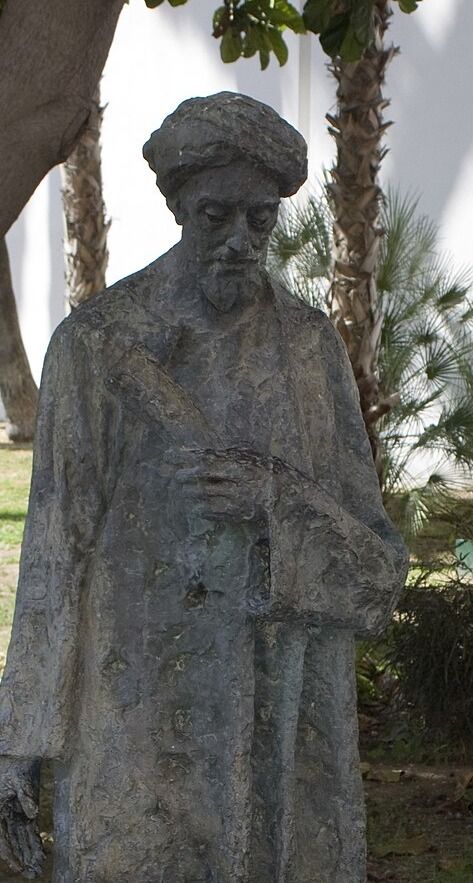

In every way, knowledge and deeds liberate the soul from the captivity of nature and purge it of its darkness and obscurity, and in this way the soul returns to its higher world.
Ibn Gabirol was born in Málaga in about 1021 or 1022 and probably died in Valencia in about 1057 or 1058. His poems suggest he was orphaned, often ill and of difficult temper; he spent time among the Jewish intellectuals of Saragossa and enjoyed a patron’s support for a while, but his relations with the Jewish community were strained. He is best known as one of the great Hebrew poets, and his poetry is religious and secular.
His philosophical dialogue, the Fountain of Life, was written in Arabic, but the original is lost apart from quotations. It survives complete in a twelfth-century Latin translation, and Christian scholastics believed its author, “Avicebron”, was either a Christian disciple of Augustine or a Muslim who had misunderstood Aristotle. Only in the nineteenth century did Solomon Munk, reading a thirteenth-century Hebrew summary, show that Avicebron was Ibn Gabirol.
Key ideas
- Universal hylomorphism
- Everything except God, including spiritual beings such as soul and intellect, is composed of matter and form. At the root of being is a purely spiritual “first matter”. Later scholastics named the doctrine, and Franciscans and Dominicans divided over it.
- The divine Will
- God is an absolutely simple unity beyond the grasp of mind and tongue, yet acts through a divine Will. There are three things to know in all existence, matter and form, the Will and the First Essence; the Will mediates between God, the cause, and matter and form, the effect.
- Knowledge and good deeds
- The whole inquiry of the Fountain of Life asks why human beings were made. The answer is a twofold task: to pursue knowledge and to do good deeds, which together free the soul from the captivity of nature.
- The return to the source
- As a Neoplatonist, Ibn Gabirol describes the soul’s ascent back to its higher world, echoing Plotinus’s account of the soul’s ascent. Through mind and deed we reclaim our truest being and our likeness to our source.
- Tradition
- Jewish
- Region
- Al-Andalus
- Period
- Judaeo-Arabic
Influences
Where these links come from
- Solomon ibn Gabirol drew on Plotinus. Source: Sarah Pessin, Solomon Ibn Gabirol [Avicebron], Stanford Encyclopedia of Philosophy
Key works
- The Fountain of Life (Fons vitae)
- On the Improvement of the Moral Qualities (Islah al-akhlaq)
Sources
- Sarah Pessin, Solomon Ibn Gabirol [Avicebron], Stanford Encyclopedia of Philosophy