Philosopher
Kūkai
774–835 CE
Also known as Kōbō Daishi, Kukai
Founder of Shingon esoteric Buddhism, often called Japan's greatest premodern systematic thinker, who taught that the cosmos is the Buddha's body and that one can become a Buddha in this very body.
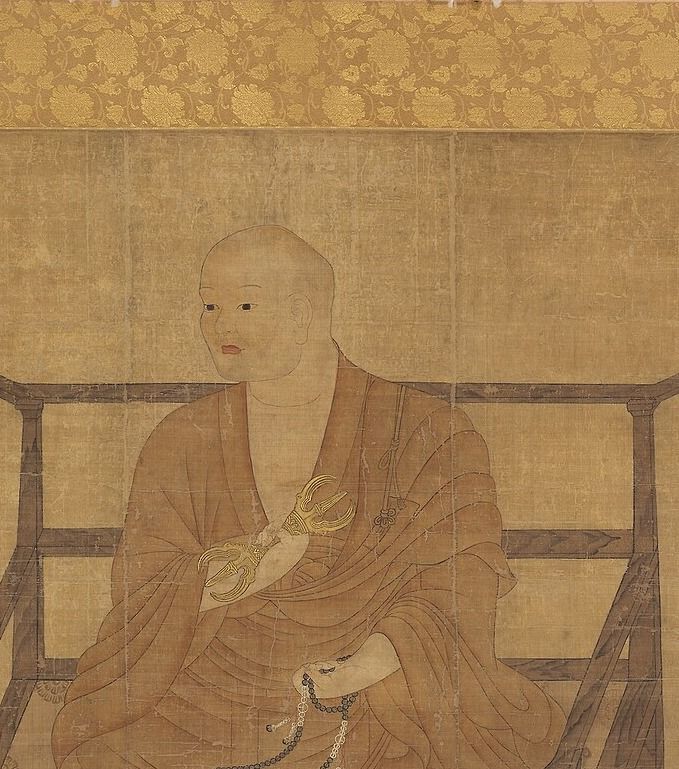
_-_1960.40_-_Art_Institute_of_Chicago.jpg)
Kūkai was born into the aristocratic Saeki family in 774, and was educated by his uncle, a Confucian scholar. He entered the state university but left it, disillusioned, for the mountains of Shikoku, where he practised as a wandering ascetic and, at 24, wrote a comparison of Confucianism, Daoism and Buddhism that explains his turn to Buddhism. Seeking a teaching that united ritual practice with doctrine, he found it in the esoteric Mahāvairocana Sūtra and in 804 sailed with an official embassy to China.
In Chang’an he studied Sanskrit and was initiated by Huiguo into both lineages of esoteric Buddhism, succeeding him as its eighth patriarch. He returned to Japan in 806 with sutras, mandalas and ritual objects, and from 809 worked in Kyoto under imperial patronage, winning official recognition for esoteric ritual. In 816 he began the monastic centre on Mount Kōya, where he died in 835. He was also celebrated as a calligrapher, poet, lexicographer and engineer, and in 921 the court gave him the title Kōbō Daishi, “Great Teacher Who Spread the Dharma”.
Key ideas
- Esoteric and exoteric teachings
- For the exoteric schools the Buddha’s truth-body (dharmakāya) is abstract and transcendent, and does not preach. For Kūkai’s esoteric Buddhism, the world seen from the Buddha’s standpoint is itself the preaching of the cosmic Buddha Dainichi, so esoteric teachings come directly from him.
- The cosmos preaches the Dharma
- Everything that happens in the universe, as it reaches our six senses, is the Buddha preaching the Dharma (hosshin seppō). Since everything that hears it is also Dainichi’s manifestation, the sermon is finally a monologue, the Buddha’s expression of his own enlightenment.
- Becoming a Buddha in this very body
- Enlightenment is attained in this embodied existence (sokushinjōbutsu). The “body” here is not just the physical body but lived existence as one whole of body and mind, which makes Kūkai’s thought a philosophy of practice and of the body.
- The three mysteries
- Dainichi expresses his enlightenment in three media, of body, speech and mind: gestures (mudras), sounds (mantras) and visualised images (mandalas). Because the cosmos is his body and mind, all its forms, resonances and patterns are these “three mysteries”.
- Ten states of mind
- In his last major work Kūkai ranked every teaching he knew as a stage in the mind’s development: three worldly stages, then the Buddhist schools, with his own esoteric Buddhism as the tenth. All of them are unfoldings of the one Dharma, at different levels, with Shingon giving the most comprehensive view.
- Tradition
- Japanese
- Region
- Heian Japan
- Period
- Classical Japanese
Key works
- Indications of the Goals of the Three Teachings (Sangō shiiki)
- Treatise on the Differences between the Esoteric and Exoteric Teachings (Benkenmitsu nikkyōron)
- On the Meaning of Becoming a Buddha in This Very Body (Sokushinjōbutsugi)
- The Ten States of Mind as a Secret Mandala (Himitsu mandara jūjūshinron), 830 CE
Sources
- John Krummel, Kūkai, Stanford Encyclopedia of Philosophy
- Thomas Kasulis and Raquel Bouso, Japanese Philosophy, Stanford Encyclopedia of Philosophy