Philosopher
John Dewey
1859–1952
Pragmatist and perhaps the most prominent American intellectual of his time, who treated thinking as a way of solving problems and saw democracy and education as bound together.
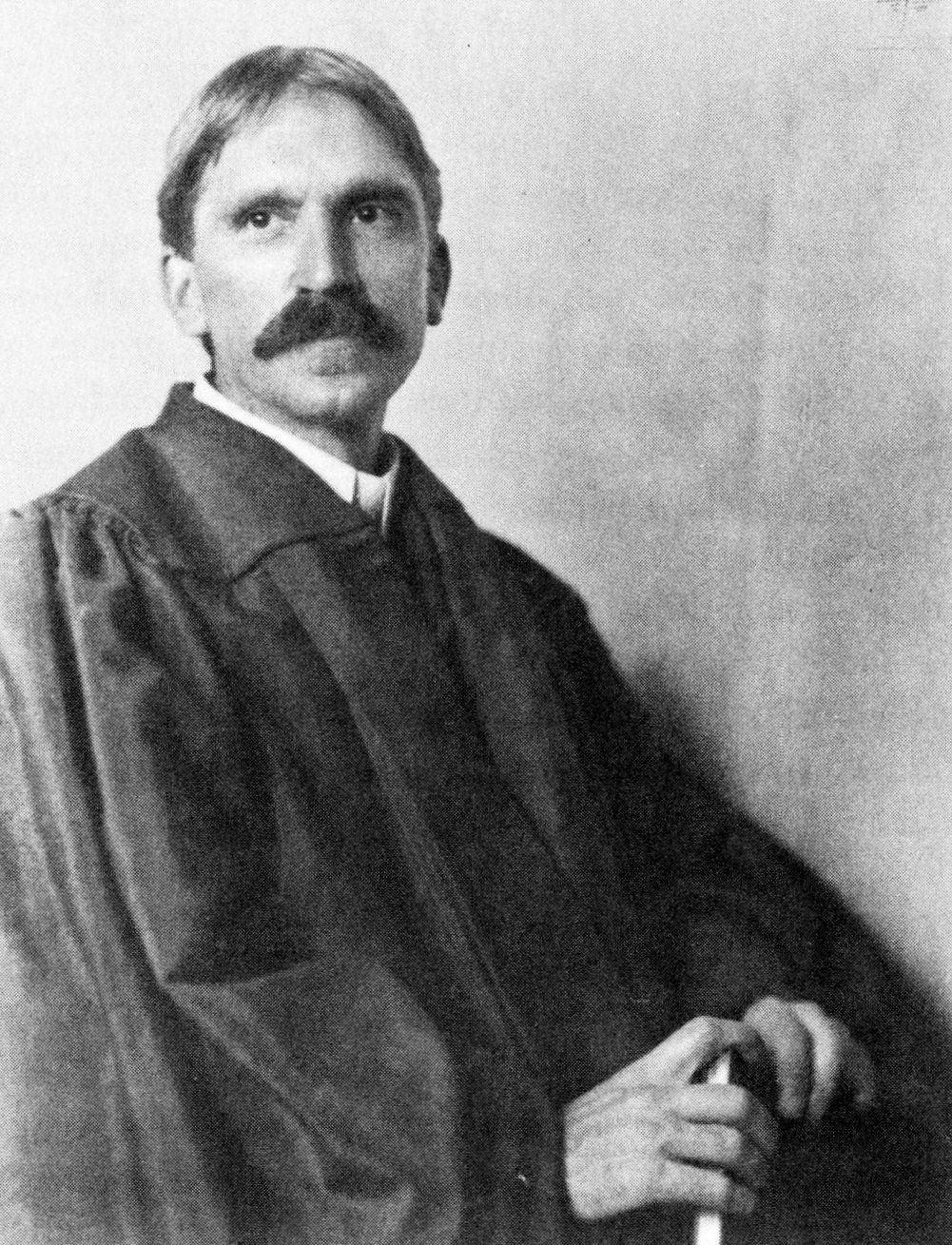

A democracy is more than a form of government; it is primarily a mode of associated living, of conjoint communicated experience.
Dewey was born in Burlington, Vermont, in 1859, and after teaching school for two years went to Johns Hopkins, where he took logic with Charles Peirce and, more importantly for him at the time, studied Hegel with George Sylvester Morris. Hegel’s influence on him was profound, and his early work tried to reconcile idealism with Darwinian biology and experimental psychology. He taught at Michigan, Minnesota and Chicago, where his department took in psychology and education, and from 1904 at Columbia University.
He wrote some forty books and about seven hundred articles, on ethics, logic, aesthetics, religion and politics, and was an active public intellectual on questions from women’s suffrage and race relations to war and peace. He lectured in Japan and China, visited schools in Turkey, Mexico and the Soviet Union, and in 1937 chaired the Trotsky Commission in Mexico City. He died in New York in 1952.
Key ideas
- Knowing as active adaptation
- Minds are not passive observers but tools that living organisms use to cope with problems. Dewey rejected the old dualisms of mind and body, self and society, and reason and emotion, treating their elements as parts of larger continuities.
- The pattern of inquiry
- Inquiry begins with a feeling that something is amiss, and moves through formulating a problem, framing a hypothesis and testing it. Dewey called logic “inquiry into inquiry”, and preferred “instrumentalism” as a name for his theory of knowledge.
- Democracy as a way of life
- Democracy is more than a form of government; it is “the idea of community life itself”. Individuals are formed in communities, and democratic life needs the habits of intelligent, experimental problem-solving.
- Learning by experience
- Schools should be places where children learn and practise democracy, not just absorb what others know. Education should develop alert observation and judgement of the conditions under which one lives.
- Art as experience
- Art, as a conscious idea, is “the greatest intellectual achievement in the history of humanity”. Aesthetics is central to philosophy’s task of making everyday experience more fulfilling and meaningful.
- Tradition
- Western
- Region
- United States
- Schools
- Pragmatism
- Period
- Late modern
Influences
Influenced by
John Dewey1859–1952
Influenced by
John Dewey1859–1952
Where these links come from
- John Dewey drew on G. W. F. Hegel. Source: David Hildebrand, John Dewey, Stanford Encyclopedia of Philosophy
- John Dewey drew on Charles Sanders Peirce. Source: David Hildebrand, John Dewey, Stanford Encyclopedia of Philosophy
- John Dewey drew on William James. Source: David Hildebrand, John Dewey, Stanford Encyclopedia of Philosophy
Key works
- Democracy and Education, 1916
- Reconstruction in Philosophy, 1920
- The Public and Its Problems, 1927
- Art as Experience, 1934
- Logic: The Theory of Inquiry, 1938
Sources
- David Hildebrand, John Dewey, Stanford Encyclopedia of Philosophy
- Catherine Legg and Christopher Hookway, Pragmatism, Stanford Encyclopedia of Philosophy