Philosopher
Hōnen
1133–1212
Also known as Honen
Tendai monk who founded the Pure Land school, teaching that simply saying Amida Buddha's name in trust, open to everyone, is the one path to liberation left in a degenerate age.
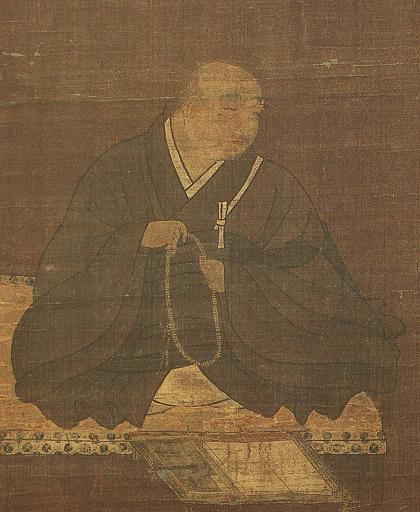

Hōnen trained and lived in the Tendai monastery on Mount Hiei, where he was widely respected for his learning, meditation and purity of purpose. Yet he was deeply aware that he could not fulfil any Buddhist practice himself, and he searched the tradition for a path that anyone could follow. He lived through political turmoil and a series of disasters, when many were convinced that Buddhism had reached its last, degenerate age (mappō), and several of Mount Hiei’s ablest monks left to lead new movements for ordinary people.
Hōnen founded the Pure Land school (Jōdoshū), the first Buddhist tradition to originate in Japan, and arguably the most radical. He set out his teaching in the Senchakushū, written in classical Chinese for learned readers, which he let only disciples copy during his lifetime. When it was published after his death, scholar-monks of the older schools attacked it. His followers divided over whether practice or faith came first, and some, such as Shinran, developed his teaching more radically.
Key ideas
- The nembutsu alone
- Simply saying “Namu-amida-butsu”, entrusting oneself to Amida Buddha’s vow to save all beings, brings birth in his Pure Land. No learning, merit, moral rectitude or other practice is needed, and there is no set manner of saying it or number of repetitions.
- Self-power and Other Power
- Traditional Buddhist practices rely on “self-power” and demand a purity no longer achievable in the present age. The nembutsu embodies “Other Power”: Amida’s wisdom and compassion at work in the world, reaching each being.
- Selection
- Faced with the overwhelming range of Tendai texts and practices, Hōnen chose to focus on a single practice rather than embrace the whole. It was Amida himself who selected the vocal nembutsu as the one practice open to all, whatever their moral qualities or capacities.
- An independent school
- Hōnen argued, from scripture and in the scholarly forms of his day, that the Pure Land path is an authentic Buddhist school, effective in itself and independent of the schools brought to Japan from the continent.
- Tradition
- Japanese
- Region
- Japan
- Period
- Classical Japanese
- Themes
- The good life
Key works
- Collection on the Nembutsu Selected in the Primal Vow (Senchaku hongan nembutsu-shū)
Sources
- Dennis Hirota, Japanese Pure Land Philosophy, Stanford Encyclopedia of Philosophy
- Thomas Kasulis and Raquel Bouso, Japanese Philosophy, Stanford Encyclopedia of Philosophy